Keep this handy at the table
Quick scoring reference
- Complete the final harvest, including feeding and breeding.
- Convert field, pasture, crop and animal counts into points using the table.
- Add fenced stables, your current house, family and card points.
- Subtract 1 per unused space and 3 per begging card.
What to count after the final harvest
Complete every step of the final round's harvest first. Grain spent on food no longer counts as a crop; remaining grain does. Animals born during breeding and kept on the farm increase their scoring category.
Leave your farm in place and prepare the score sheet. Follow its order: agriculture, then buildings and family, then cards and penalties. This helps catch easily missed fenced stables or vegetables still in fields.
For crops, combine your personal supply with tokens still in fields. Check resources on special cards against their wording. Food itself scores no ordinary VP. Do not convert spare wood or reed into points without a specific effect allowing it.
Fields, pastures, crops and animals: the scoring table
In the first seven categories, component counts are not point values. Find the correct range and record the corresponding score. Missing a category usually means −1. One easily missed exception: even a single field still scores −1.
A pasture is one separately fenced area, rather than each enclosed space. A four-space pasture counts as one pasture here. Its size affects animal capacity but does not multiply this scoring category.
| Category | Quantity | Points |
|---|---|---|
| Fields | 0–1 / 2 / 3 / 4 / 5+ | −1 / 1 / 2 / 3 / 4 |
| Pastures | 0 / 1 / 2 / 3 / 4+ | −1 / 1 / 2 / 3 / 4 |
| Grain | 0 / 1–3 / 4–5 / 6–7 / 8+ | −1 / 1 / 2 / 3 / 4 |
| Vegetables | 0 / 1 / 2 / 3 / 4+ | −1 / 1 / 2 / 3 / 4 |
| Sheep | 0 / 1–3 / 4–5 / 6–7 / 8+ | −1 / 1 / 2 / 3 / 4 |
| Wild boar | 0 / 1–2 / 3–4 / 5–6 / 7+ | −1 / 1 / 2 / 3 / 4 |
| Cattle | 0 / 1 / 2–3 / 4–5 / 6+ | −1 / 1 / 2 / 3 / 4 |
House, family, stables and unused spaces
Each family member scores 3 points. Clay house rooms score 1 each, stone rooms 2 and wooden rooms no ordinary points. Count only your house's current material. Four rooms renovated from clay to stone are four stone rooms, not two sets of rooms.
Each fenced stable adds 1 point. Subtract 1 per unused farmyard space. A space with an unfenced stable is used, even though that stable earns no fenced-stable bonus.
Keep printed points on built improvements separate from variable card bonuses. Each begging card costs 3 points. Before totaling, check empty spaces row by row rather than trying to reconstruct their number from memory.
Worked example: scoring a farm
After the final harvest, a player has 4 fields, 2 pastures, 6 grain, 2 vegetables, 4 sheep, 3 wild boar and 2 cattle. These seven categories score 3 + 2 + 3 + 2 + 2 + 2 + 2 = 16 points.
They also have 2 unused spaces, 2 fenced stables, 4 stone rooms and 4 family members. Printed improvement points total 5 and variable card bonuses total 3. There is one begging card.
To the agricultural subtotal of 16, add 2 for stables, 8 for the house, 12 for family and 8 for cards. Subtract 2 for unused spaces and 3 for begging. The final score is 41. All counts are after feeding, so no further resources need to be spent.
| Category | Calculation | Points |
|---|---|---|
| Fields, pastures, crops and animals | 3 + 2 + 3 + 2 + 2 + 2 + 2 | 16 |
| Unused spaces | 2 × −1 | −2 |
| Fenced stables | 2 × 1 | 2 |
| Stone house | 4 × 2 | 8 |
| Family members | 4 × 3 | 12 |
| Improvement points | Calculated total | 5 |
| Card bonuses | Calculated total | 3 |
| Begging cards | 1 × −3 | −3 |
| Total | Sum of categories | 41 |
Work it out16 − 2 + 2 + 8 + 12 + 5 + 3 − 3 = 41 points
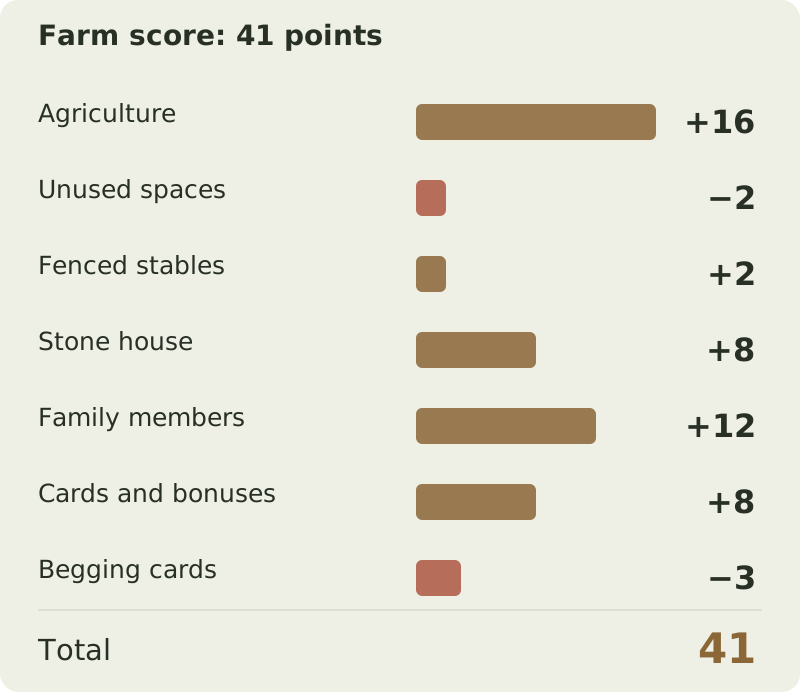
Entering your farm in the calculator
Choose Original edition or Revised Edition to match your copy. Enter quantities in the first fields: 4 fields, 2 pastures, 6 grain and so on. Do not enter the 3 or 2 points these counts earn. The calculator finds each scoring range automatically.
Use only one house field: 4 stone rooms in this example, with clay rooms left at zero. Enter the calculated totals of 5 and 3 for printed card points and card bonus points. These depend on your particular cards and must be checked manually.
Enter 1 begging card, not −3. The negative multiplier is built in. Blank fields mean zero components; zero crops or animals may incur a penalty, so an empty calculator need not show a zero total.
Cards, editions and tied scores
The standard table handles base scoring, but a card may change what counts or award its own bonus. Resolve the card first, then enter the result in the appropriate category. Agricola: All Creatures Big and Small uses a different system and is outside this calculator's scope.
Check the tiebreaker in your copy. The original edition shares a points tie. Published Agricola Revised Edition rules first compare remaining building resources; if still tied, share the place.
In Revised Edition mode, enter Building resources as the total wood, clay, reed and stone left in your supply. This value breaks points ties and adds nothing to the ordinary total. Original edition mode leaves tied scores as shared victories.
Checks before announcing the winner
- Count unplanted field tiles as fields, and include crops still on fields with those in your supply.
- Do not confuse pasture count with the area enclosed by fences.
- After renovation, score rooms only for their current material.
- An unfenced stable gets no fenced-stable bonus, but its space is used.
- Subtract 3 per begging card and remember penalties for missing farm categories.
Try it yourself
Try the example with your own numbers
Change the values to see how the score changes. This is a practice calculation; your saved game in the calculator is kept separately.
Questions & answers
Does grain still planted in a field count?
Yes. After the final harvest, combine grain in your supply with grain still in fields. Count vegetables the same way.
Why does an empty calculator show penalties?
Zero components in several categories score −1 rather than zero. Having no sheep or no vegetables, for example, incurs a penalty.
Can I score wooden rooms as clay rooms?
No. Use the actual house material at game end. Wooden rooms score no ordinary victory points.
Calculator profiles and fields
Check which inputs your version needs before you start. Quantity fields are converted into points automatically; points fields expect a score you have already worked out.
Original edition
| Field | What to enter |
|---|---|
| Fields | Enter the quantity. |
| Pastures | Enter the quantity. |
| Grain | Total in your supply and planted in fields. |
| Vegetables | Total in your supply and planted in fields. |
| Sheep | Enter the quantity. |
| Wild boar | Enter the quantity. |
| Cattle | Enter the quantity. |
| Unused farmyard spaces | −1 VP per unused space. |
| Fenced stables | 1 VP per stable inside a pasture. |
| Clay house rooms | 1 VP per room. |
| Stone house rooms | 2 VP per room. |
| Family members | 3 VP each. |
| Printed card points | Printed VP on improvements. |
| Card bonus points | Variable bonuses from occupations and improvements. |
| Begging cards | −3 VP per card. |
Revised Edition
| Field | What to enter |
|---|---|
| Fields | Enter the quantity. |
| Pastures | Enter the quantity. |
| Grain | Total in your supply and planted in fields. |
| Vegetables | Total in your supply and planted in fields. |
| Sheep | Enter the quantity. |
| Wild boar | Enter the quantity. |
| Cattle | Enter the quantity. |
| Unused farmyard spaces | −1 VP per unused space. |
| Fenced stables | 1 VP per stable inside a pasture. |
| Clay house rooms | 1 VP per room. |
| Stone house rooms | 2 VP per room. |
| Family members | 3 VP each. |
| Printed card points | Printed VP on improvements. |
| Card bonus points | Variable bonuses from occupations and improvements. |
| Begging cards | −3 VP per card. |
| Building resources | Total wood, clay, reed and stone in your personal supply. Used only to break ties. |
Sources and verification
Prepared by Board Game Scoreboard. Rules checked against the sources below on November 17, 2026; the worked example is checked during each site build. If editions differ, follow the rulebook included with your copy.
- Agricola Revised Edition — official Lookout Games rules ↗
- Agricola Revised Edition — detailed scoring appendix ↗
- Agricola — original edition rules ↗
Ready to score your game?
Enter each player's results to see the total and a full breakdown.
Go to calculator ↗