Keep this handy at the table
Quick scoring reference
- Finish production and final greenery placement under the rules.
- Record your final terraform rating.
- Add milestones, funded awards, greenery, cities and cards.
- Break points ties using remaining megacredits.
Before you start scoring
Keep ownership cubes on the board and resources on cards: you still need them for checking. Finish the last generation, production and final greenery placement. Players may place their remaining greenery under normal conditions while they have enough plants. New tiles can change their own score and the value of neighboring cities.
Prepare six scoring lines. It is often easiest to score one category for every player before moving on: terraform rating, then milestones, and so forth. If the manual result differs from the calculator, you can compare one category instead of recounting the entire game.
The scoring categories
Your terraform rating already includes increases earned during play. Use the marker's final position in full. Megacredit production is a different value and is not added to your rating.
A milestone scores only for the player who claimed and paid for it. Merely meeting its condition by game end is not enough. For cards, include printed points, negative values and variable resource-based points: score animals, for example, according to the particular card's text.
| Category | What to record |
|---|---|
| Terraform rating | 1 point per final terraform rating |
| Milestones | 5 points per claimed milestone |
| Awards | Points from funded awards only |
| Greenery | 1 point per greenery tile you own |
| Cities | 1 point per adjacent greenery tile for each of your cities |
| Cards | Printed and conditional points from played cards |
Scoring cities and greenery
First count your own greenery tiles: each scores 1 point regardless of its neighbors. Then check the six adjacent spaces around each of your cities. Any neighboring greenery scores 1 point for the city, even if another player owns it. An ordinary city has no additional flat end-game placement value.
If one city has five adjacent greenery tiles and another has four, city points total 9. A greenery tile touching both your cities counts for both. This repeated use of adjacency is allowed. Only the greenery's owner receives the separate point for owning that tile.
Awarding points for awards
Check only awards someone funded. Winners are determined by end-of-game values; funding an award gives no automatic advantage. First place scores 5. With three or more players, a sole leader leaves a second-place award worth 2. There are no second-place award points in a two-player game.
If first place is tied, each leader scores 5 and there is no second-place award. Every player tied for second scores 2. Values of 12, 9 and 9 therefore award 5, 2 and 2; values of 12, 12 and 9 award 5, 5 and 0.
A complete worked example
In a two-player game, Anna has a terraform rating of 34, one claimed milestone, seven greenery tiles and two cities adjacent to nine greenery tiles in total. Her cards score 18. The Scientist award was funded, and Anna wins it with seven science tags against her opponent's five.
Add the category scores in the table. Her remaining 32 megacredits do not increase the 78-point total: they matter only in a tie.
| Category | Calculation | Points |
|---|---|---|
| Terraform rating | Final track position | 34 |
| Milestone | 1 × 5 | 5 |
| Award | First place | 5 |
| Greenery | 7 × 1 | 7 |
| Cities | 5 + 4 | 9 |
| Cards | Sum of printed values | 18 |
Work it out34 + 5 + 5 + 7 + 9 + 18 = 78 points
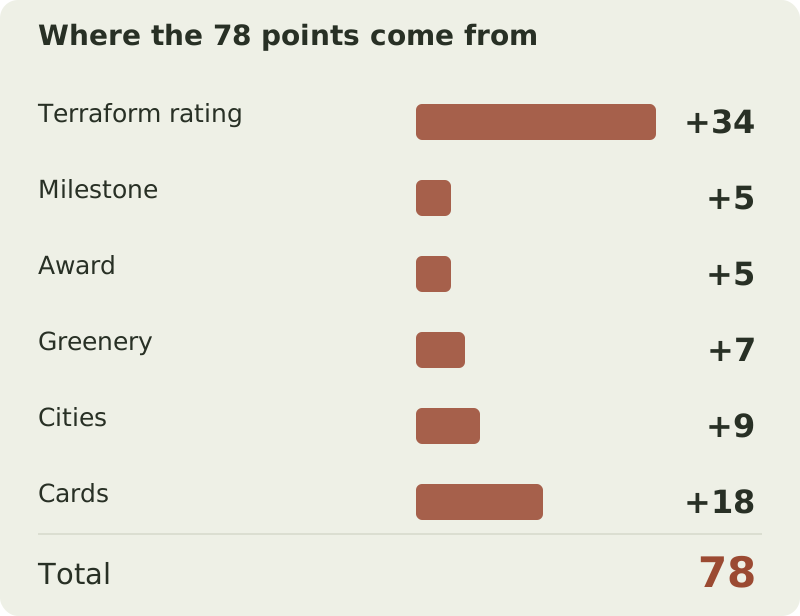
Entering the result in the calculator
Enter Terraform rating 34, Milestones 1, Greenery 7, City VP 9 and Card VP 18. Milestones and greenery take quantities; cities and cards take points already calculated. Enter 32 under M€ remaining.
Enable the funded award and enter its value for every player: 7 and 5 in this example. Do not put the 5 award points into Card VP; the calculator awards them automatically. Select the total to compare its breakdown with the guide's table.
Other maps and expansions
New project cards may add conditional points. Work these out from their text and include them under cards. Hellas, Elysium and other boards replace milestones and awards, so the five award names and metrics in this calculator do not automatically apply to them.
This guide covers ordinary competitive play. Ares Expedition, The Dice Game and solo victory conditions use separate systems. When combining expansions, resolve their own end-of-game steps before recording final values.
Common points of confusion
- Adding money production to the score. Use terraform rating for the total; production may instead be a particular award's metric.
- Counting only your own greenery around a city. The owner of adjacent greenery does not affect city scoring.
- Scoring 5 for an unclaimed milestone. It must be met and claimed during play.
- Missing negative event points or counting cards in hand. Check played cards and their exact text.
Try it yourself
Try the example with your own numbers
Change the values to see how the score changes. This is a practice calculation; your saved game in the calculator is kept separately.
Questions & answers
Do megacredits score victory points?
Ordinary remaining megacredits do not score. If final points tie, the player with more money wins.
Who scores for another player's greenery next to my city?
The greenery's owner scores for their tile. You score separately for that tile's adjacency to your city.
Must I fund an award to win it?
No. Any player can win a funded award; compare everyone's final values.
Sources and verification
Prepared by Board Game Scoreboard. Rules checked against the sources below on November 17, 2026; the worked example is checked during each site build. If editions differ, follow the rulebook included with your copy.
How we prepare our guidesReady to score your game?
Enter each player's results to see the total and a full breakdown.
Go to calculator ↗