Keep this handy at the table
Quick scoring reference
- Move tiles to the wall from top to bottom, scoring adjacency immediately.
- Subtract occupied floor line penalties at the end of the round.
- At game end, add 2 per complete row, 7 per column and 10 per color.
- Break points ties by the number of complete horizontal rows.
Which parts of the player board score?
Distinguish the pattern lines on the left from the wall on the right. A tile scores when moved from a complete pattern line to the wall. Filling a pattern line is not a separate award. Resolve lines from top to bottom; an earlier tile may increase the next tile's value.
The floor line is the penalty row along the bottom. The score track records completed rounds. For final scoring, use its value after the last wall tiling and floor penalty. Marking that subtotal on paper helps distinguish points already recorded from bonuses still to add.
Scoring a newly placed tile
A tile with no horizontal or vertical neighbors scores 1 point. If it joins a continuous horizontal line, count that entire line, including the new tile. Check the vertical line in the same way. An empty space breaks a line; diagonal neighbors do not count.
If a tile joins both a horizontal and a vertical line, add both lengths. A placement completing a three-tile horizontal line and a two-tile vertical line scores 3 + 2 = 5. The new tile counts in both lines: do not subtract one for the intersection.
For another example, two tiles sit immediately to the left, with a further tile beyond a gap on the right. The continuous horizontal line including your new tile has length three. The distant tile beyond the gap does not count. Following the spaces is more reliable than counting every tile in the row.
Subtracting floor line penalties
After wall tiling, subtract the values above occupied floor spaces, filled from left to right. The first two spaces cost 1 each, the next three cost 2 each and the final two cost 3 each. Three occupied spaces therefore mean −4, not −3. The first player marker also occupies a space and incurs its penalty.
A penalty cannot reduce your score below zero. Earning 3 points and taking a 4-point penalty leaves you at 0. Clear the floor under the rules; do not carry a penalty into the next round. The final-score calculator has no separate floor field because all penalties must already be included in the track score.
Bonuses to add at game end
The game ends after a wall tiling phase in which at least one player completes a horizontal wall row. Everyone still finishes that round's tiling and penalties. Then each player checks their entire wall for three bonus types.
A complete color means all five tiles of that color on the wall, not in pattern lines or elsewhere. A tile may contribute to a complete row, column and color at once: these bonuses stack. Award them once, at game end.
| What is complete on the wall | Bonus |
|---|---|
| Horizontal row of 5 tiles | 2 points per row |
| Vertical column of 5 tiles | 7 points per column |
| All 5 tiles of one color | 10 points per color |
Worked final score: 95 points
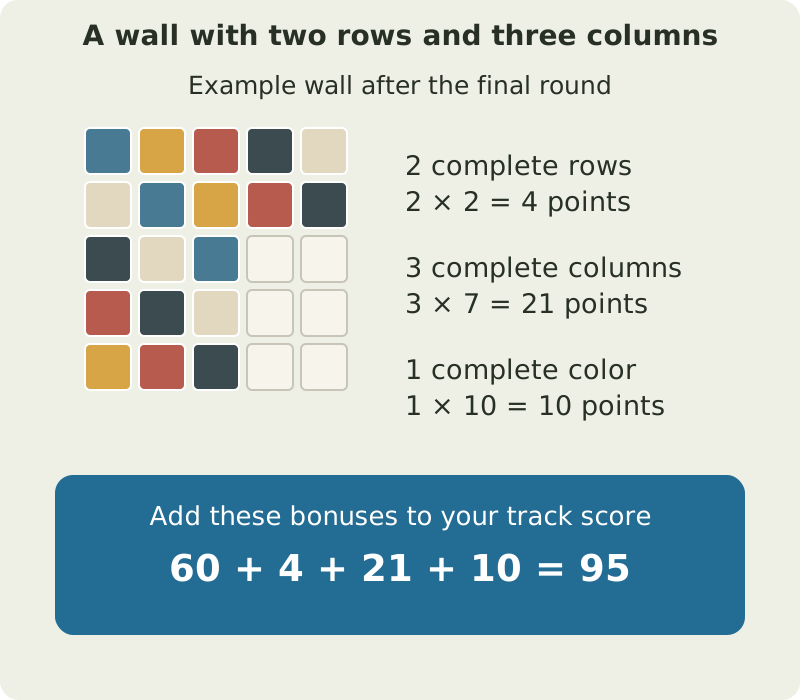
After the last round and penalties, Anna has 60 on the score track. Her wall has two complete horizontal rows, three complete vertical columns and one complete color. Convert these counts into bonuses, then add them to the track.
Two rows score 4, three columns score 21 and the complete color scores 10. Final bonuses total 35, giving Anna 95. Do not reconstruct placement points from the finished wall: they are already included in the original 60.
| Category | Calculation | Points |
|---|---|---|
| Track | After all rounds and penalties | 60 |
| Complete rows | 2 × 2 | 4 |
| Complete columns | 3 × 7 | 21 |
| Complete color | 1 × 10 | 10 |
Work it out60 + 2 × 2 + 3 × 7 + 1 × 10 = 95 points
Using the Azul calculator
Enter Score track 60, Complete rows 2, Complete columns 3 and Complete colors 1. The calculator applies the multipliers. The last three fields take counts, not the resulting 4, 21 and 10 points.
If your track already reads 95 including bonuses, entering the rows and columns again will inflate the score. For an accurate breakdown, use the pre-bonus value of 60. Points ties go to the player with more complete horizontal rows; if still tied, share the victory.
The reverse wall and other Azul games
The gray side gives you more freedom to choose color placement, but row and column restrictions still apply. Adjacency, penalties and final multipliers remain the same, so the same final-score calculator works for a legally filled wall.
Azul Mini and editions with differently sized components use the same calculation when they retain the base rules. Stained Glass of Sintra, Summer Pavilion and other standalone games do not use this guide's formulas. Check whether extra boards change goals or final bonuses.
Common mistakes
- Counting only immediate neighbors. Follow the whole continuous line to the first gap.
- Counting diagonals. They add no points to a normal placement.
- Subtracting the floor again after entering the track. The final penalty should already be included.
- Awarding complete-row bonuses every round. The 2, 7 and 10-point bonuses are added only at game end.
Try it yourself
Try the example with your own numbers
Change the values to see how the score changes. This is a practice calculation; your saved game in the calculator is kept separately.
Questions & answers
Does the new tile count twice at an intersection?
Yes. If it joins both a continuous horizontal and vertical line, include it in each length and add the two results.
What is the penalty for three floor tiles?
The first three spaces cost 1 + 1 + 2 = 4 points. The first player marker can also occupy one of these spaces.
Can I win without completing a row?
Yes. A completed row triggers the game end, but final points determine the winner.
Sources and verification
Prepared by Board Game Scoreboard. Rules checked against the sources below on November 17, 2026; the worked example is checked during each site build. If editions differ, follow the rulebook included with your copy.
How we prepare our guidesReady to score your game?
Enter each player's results to see the total and a full breakdown.
Go to calculator ↗