Keep this handy at the table
Quick scoring reference
- Choose the feature and determine the meeple majority.
- Check whether it is complete and apply the relevant expansion rules.
- Count tiles, shields or completed cities bordering the field.
- Award the full value to every player tied for majority control.
Where to start when scoring a feature
A tile is a square landscape piece; a meeple is a player's figure. Trace the boundaries of the particular road, city or field first. A tile may contain parts of several features: score only the feature occupied by the figure. If one connected feature covers several parts of the same tile, count that tile once for that feature.
Next compare the strength of each player's figures on the feature. The player with the majority scores. If two players each have one meeple, both score the full value, rather than half. If one has two meeples and the other has one, only the first scores. A large meeple counts as two ordinary meeples for control; it does not double the feature's value.
Road, city and monastery values
A road is complete when all its ends terminate as the tile rules require, for example at a city, junction or monastery. A city is complete when its wall has no gaps. A monastery is complete when all eight surrounding spaces contain tiles.
At the end of the game, ordinary incomplete roads score the same per tile as completed roads. Cities use a lower multiplier. For a monastery, count its own tile and the tiles actually surrounding it, including diagonals.
| Base game feature | During play | At game end, if incomplete |
|---|---|---|
| Road | 1 point per tile | 1 point per tile |
| City | 2 points per tile, plus 2 per shield | 1 point per tile, plus 1 per shield |
| Monastery | 9 points when fully surrounded | 1 for the monastery + surrounding tiles |
| Field with farmers | Not normally scored | 3 points per completed city bordering the field |
Worked example: a four-tile city with a shield
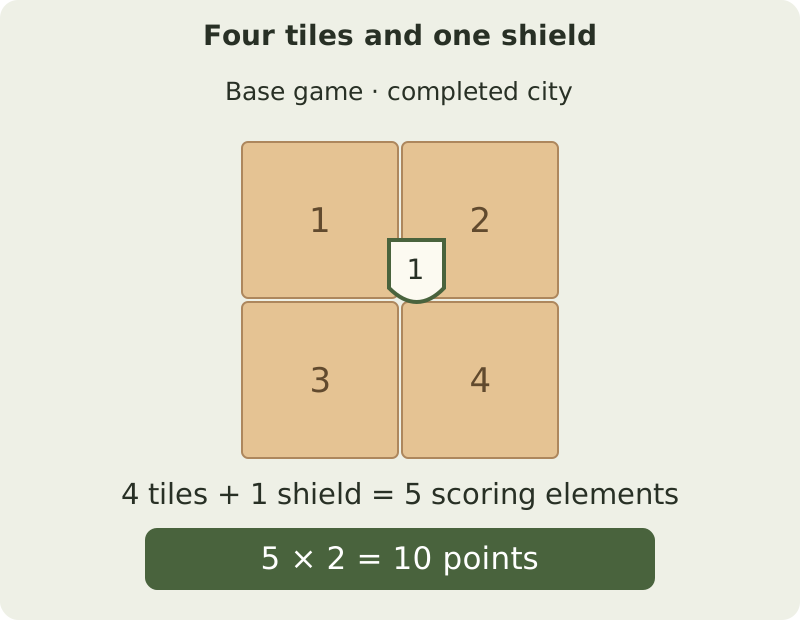
A completed city covers four tiles and contains one shield. Anna has one meeple there, with no opposing figures. The tiles score 4 × 2 = 8, and the shield adds 2. Anna scores 10 points and returns her meeple to her supply.
If the same city remained incomplete at game end, it would score 4 + 1 = 5. If Anna and Ben each had one meeple in the completed city, each would score 10. A feature's value is not divided between tied majority holders.
| What we count | Calculation | Points |
|---|---|---|
| Tiles in the completed city | 4 × 2 | 8 |
| Shield | 1 × 2 | 2 |
Work it out(4 tiles + 1 shield) × 2 = 10 points
Scoring fields and farmers
Score fields after the other features. Trace the continuous green area: roads, walls and other boundaries can divide fields. Determine the farmer majority across the entire field, then count the completed cities it borders. The field's area in tiles does not affect its value.
Count a completed city once per field, even if the field touches it in several places. Incomplete cities score nothing for farmers. A field bordering three distinct completed cities normally scores 3 × 3 = 9. The same city can score for multiple separate fields.
Calculating your full game score
If you used the score track during play, start with that total. Add only incomplete features, fields and final expansion bonuses. For example, 42 on the track, an incomplete road worth 4, a city worth 5, a monastery worth 6 and a field worth 9 give 66 points. Do not add a previously scored completed city again.
If you recorded every scoring event in the calculator, its entries already form your total. Do not add the physical track score: both records represent the same awards. Players with equal final totals share their place.
Using the score tracker
Choose expansions and rule editions first. Add players, then select the feature, size and completion status for each scoring event. For this example, choose City, 4 tiles, 1 shield and completed. Select Anna as the recipient and record the entry.
For a monastery, enter 0–8 surrounding tiles; the tracker adds the monastery itself. For a field, enter completed cities. You select recipients after comparing meeples on the table. History and undo help correct accidental entries; each rules configuration has its own save.
Expansions and the 2025 rule changes
Inns & Cathedrals: a completed road with an inn scores 2 per tile; a completed city with a cathedral scores 3 per tile and shield. Multiple inns or cathedrals do not stack. Under classic rules, incomplete features with them score 0. Under the 2025 rules, they score normally: 1 per road tile, or 1 per city tile and shield.
Traders & Builders: a classic pig increases its owner's field value to 4 per completed city, provided that player shares the majority. In the 2025 edition, a pig scores as a separate event after a city with a shield is completed: 3 per completed city bordering its field, regardless of majority, then it returns to supply. The pig itself gives no final-game points.
Goods award 10 points for the most tokens of each type; every tied leader receives 10. Enter all players' goods and enable their final scoring: do not duplicate the bonus in the feature history. The River changes the opening tile placement but awards no points itself.
Common mistakes
- Splitting a city's value. Every tied majority holder receives the full value.
- Counting incomplete cities for a field. Farmers score only completed cities.
- Counting a shield as an extra tile and then again as a shield. Record square tiles and shield symbols separately.
- Choosing 2025 rules automatically for classic components. Check each expansion's booklet for its edition.
Try it yourself
Try the example with your own numbers
Change the values to see how the score changes. This is a practice calculation; your saved game in the calculator is kept separately.
Questions & answers
Can I score a feature without a meeple on it?
In the base game, normal feature points go to the players with the meeple majority there. Goods and some expansion effects follow separate rules.
What is an incomplete monastery worth?
1 point for the monastery itself, plus 1 per surrounding tile in its eight neighboring spaces, including diagonals.
Does having more meeples give me more points?
Majority determines who scores, but does not increase the feature's value. Every tied majority holder scores its full value.
Sources and verification
Prepared by Board Game Scoreboard. Rules checked against the sources below on November 17, 2026; the worked example is checked during each site build. If editions differ, follow the rulebook included with your copy.
- Carcassonne — Hans im Glück base rules ↗
- Carcassonne — supplementary rules for fields, The River and The Abbot ↗
- Traders & Builders — classic rules ↗
- Inns & Cathedrals — classic rules ↗
- Inns & Cathedrals — 2025 rules ↗
- Traders & Builders — 2025 rules ↗
Ready to score your game?
Enter each player's results to see the total and a full breakdown.
Go to calculator ↗