Keep this handy at the table
Quick scoring reference
- Score A and B in spring, B and C in summer, C and D in autumn, D and A in winter.
- Each season adds every coin marked by that moment.
- Subtract distinct empty spaces adjacent to monsters.
- Record scores immediately; the final map cannot reconstruct earlier states.
Scoring starts before winter
Do not wait until the end of the game to evaluate the map in one pass. Edicts inspect it four times, with forests, villages, water and farms appearing between evaluations. At each season end, record both edict scores, coins and monster penalties. The final calculation then simply combines four preserved seasonal subtotals.
First confirm that the season’s time threshold has been reached and the final shape drawn. Find the two required edict letters on the season card. A season ending does not let you alter previous shapes or cover extra spaces beside monsters. Score the sheet as it actually stands, including awkward placements and gaps left uncovered.
Why each edict scores twice
Spring uses A and B, summer B and C, autumn C and D, and winter D and A. Each objective scores twice, but its value can change. For example, a forest objective may score eight in spring and eleven in winter after the forest expands. Copying its earlier result without checking the map can lose earned points.
Read each scoring card fully: some count spaces, others count separate clusters, rows or columns. Edge connections differ from corner contact. If an objective refers to one largest cluster, do not add every similar cluster together. These spatial checks are manual in the calculator, so a brief note explaining each subtotal is useful for later verification.
Accumulated coins score again
Each marked coin symbol scores one point at the end of every remaining season. If two coins were present in spring and two more appeared in summer, enter two in spring and four in summer. This repeated scoring is intentional. Entering only newly gained coins understates later seasonal totals and changes the value of early income.
Accumulated coin counts cannot decrease. A sequence of 2, 4, 5, 6 is possible; 2, 4, 3, 6 needs checking. The calculator flags such a decrease. Inspect the entire coin track, including rewards from surrounded mountains. Mountains do not produce an additional separate award on top of the coin symbol already marked for surrounding them.
Count empty spaces rather than exposed sides
Each empty space sharing an edge with a monster costs one point. If it touches two or three monsters, it still costs only one. Work around the monster areas and lightly mark empty spaces already counted. Spaces containing another drawn terrain are not empty. Diagonal contact does not cause the normal monster penalty.
Check this penalty every season too. A gap filled in summer no longer costs points in autumn, but its earlier spring penalty remains recorded. Do not replace the four rows with a single final-map monster evaluation. Total penalties also resolve ties, so the whole game’s losses matter rather than only the safety of the map after the final winter shape.
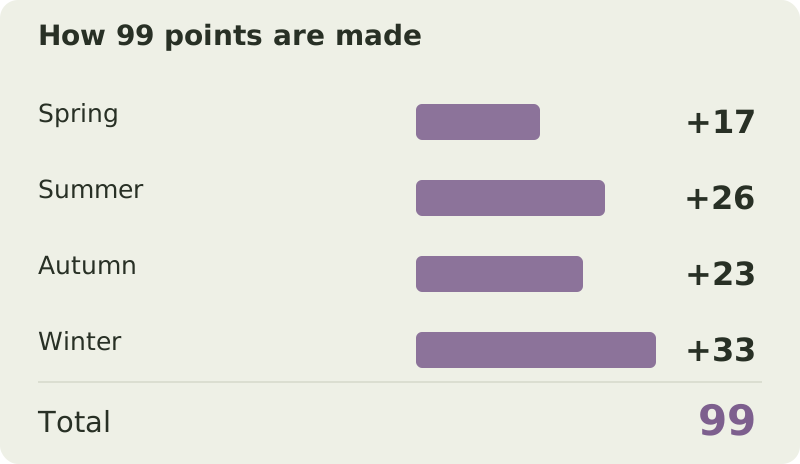
Four-season example: 99 points
In spring, edicts score 8 and 10, coins are 2 and exposed monster spaces 3, giving 17. Summer has edicts 14 and 9, coins 4 and penalty 1, giving 26. Autumn has 12 and 8, coins 5 and penalty 2, giving 23. Winter has 16 and 11, coins 6 and no penalty, giving 33.
The season totals add to 17 + 26 + 23 + 33 = 99. Monster penalties total six. If another player also scores 99 but lost eight points to monsters, our player wins. If those losses also tie, share victory. A prettier or more completely filled map does not become another independent tiebreak criterion.
Using the seasonal entries
For each season, enter the calculated first and second edict scores, accumulated coins and penalised-space count. Enter the penalty as a positive count; the form subtracts it. Do not enter the complete seasonal subtotal as an edict score, or coins and monsters will apply twice. Correct earlier entries from preserved records because the current map has already changed.
Base maps and solo rating
Both base-map sides use the same seasonal structure. Map Packs and Heroes can introduce additional checks that this profile does not reconstruct. Solo play first calculates the normal score and then subtracts the scoring cards’ difficulty values to determine rating. This profile displays the ordinary game score; perform the additional rating conversion using the solo rules.
Checks before final comparison
- Do not copy an earlier edict score after the map has changed.
- Do not count one empty space twice because it borders two monsters.
- Do not enter only the season’s newly gained coins.
- Do not replace a negative season with zero: penalties can exceed its points.
Try it yourself
Try the example with your own numbers
Change the values to see how the score changes. This is a practice calculation; your saved game in the calculator is kept separately.
Questions & answers
Can a seasonal score be negative?
Yes. If monster penalties exceed edict and coin points, preserve the negative result and include it in the total. There is no zero floor.
Should earlier monster losses be removed once gaps are filled?
No. Each season records its own evaluation. Filling a gap prevents future penalties but does not refund points lost in previous seasons.
Sources and verification
Prepared by Board Game Scoreboard. Rules checked against the sources below on November 17, 2026; the worked example is checked during each site build. If editions differ, follow the rulebook included with your copy.
How we prepare our guidesReady to score your game?
Enter each player's results to see the total and a full breakdown.
Go to calculator ↗