Keep this handy at the table
Quick scoring reference
- Score each of the five wildlife types using its active Scoring Card.
- For each habitat, identify only its single largest connected corridor.
- Enter every player’s corridor sizes so the calculator can compare them.
- Add unused Nature Tokens and check the tiebreaker if totals are equal.
Prepare the layouts and Wildlife Scoring Cards
Wait until the game ends and leave the Wildlife Tokens in place. In a normal game every player takes twenty turns, but different Scoring Cards can reward very different group arrangements. Place all five selected cards beside the shared display. The same group of Salmon need not have the same value in two different games.
Score wildlife first and habitats second, keeping their different adjacency requirements separate. For each animal, check restrictions involving group size, shape and surrounding tokens. The calculator cannot see the layout, so enter the victory points already determined from the selected cards for Bears, Elk, Salmon, Hawks and Foxes.
Find the largest habitat corridor
A habitat corridor consists of matching habitat tiles connected along matching edges. Trace the entire connected area without jumping across a different habitat. For each of the five habitats, record only your largest corridor. Two disconnected Forest corridors of four and six tiles score six habitat points, not ten.
A dual-habitat tile can contribute to two different habitat types, but it counts only once within a particular corridor. The Wildlife Token occupying it does not change the corridor’s size. To check the result, trace the area’s boundary and then count its tiles row by row without moving the animal tokens.
Majority bonuses and tied corridor sizes
In a two-player game, compare the largest corridors for each habitat. The larger corridor gains two additional points. If the sizes are equal, both players gain one, and there is no separate second-place award. These bonuses are added to the points for the tiles themselves. Compare all five habitats, because several small advantages can meaningfully change the final result.
With three or four players, first place gains three and an uncontested second gains one. Two players tied for first gain two each, with no next-place bonus. If three or four tie for first, each gains one. Any tie for second awards nothing to those players. The form compares every entered player, so fill in the opponents’ corridor sizes as well.
Two-player worked example: 102 points
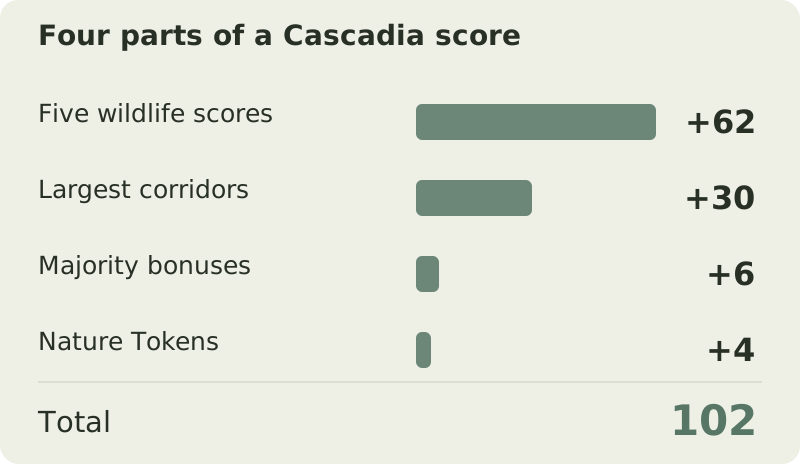
Suppose Anna’s wildlife scores are 12, 14, 11, 9 and 16, totaling 62. Her Mountains, Forests, Prairies, Wetlands and Rivers have largest corridors of 7, 6, 5, 8 and 4. Boris’s sizes in the same order are 5, 6, 7, 3 and 4. Anna also has four unused Nature Tokens. His wildlife scores do not affect this habitat comparison.
Anna’s corridors themselves score 30. Majority bonuses are 2 for Mountains, 1 for the tied Forest, 0 for Prairies, 2 for Wetlands and 1 for the tied River, totaling 6. Her four tokens add another 4. The final result is 62 + 30 + 6 + 4 = 102. In the interactive example, Boris’s corridor sizes remain fixed when you change Anna’s values.
Work it out62 + 30 + 6 + 4 = 102 points
Tile quantities versus calculated points
The first five fields contain calculated wildlife scores. The next five contain tile counts for your largest corridors. The last contains unused Nature Tokens. Do not enter a calculated majority bonus as a Forest size: the form would compare the wrong number with the opponents and award additional points that the actual layout does not earn.
For the example, enter wildlife scores 12, 14, 11, 9, 16; corridor sizes 7, 6, 5, 8, 4; and 4 Nature Tokens. Add Boris and fill in his corridor sizes. The breakdown lists each habitat’s base points separately from its bonus, making it easier to distinguish an incorrect corridor count from an incorrect comparison.
Solo play and other variants
In solo play, each corridor containing at least seven tiles gains two additional points instead of an opponent comparison. Leave one player in the form to use this rule. In a multiplayer tied total, more unused Nature Tokens win; if those are also equal, the victory is shared. These tokens have already contributed their ordinary scoring points.
Family and intermediate wildlife cards change how the wildlife points are obtained, while scenarios may modify further rules. Check the chosen variant before using the standard sheet. Landmarks introduces its own rules and a different player range; its awards and comparisons cannot silently be transferred to this one-to-four-player base-game profile.
Common scoring mistakes
- Adding disconnected areas of one habitat instead of selecting the largest.
- Awarding second place after a tie for first.
- Splitting one point between tied second places; the base game awards them zero.
- Adding bonuses twice by including them in a corridor-size input.
Try it yourself
Try the example with your own numbers
Change the values to see how the score changes. This is a practice calculation; your saved game in the calculator is kept separately.
Two players. Boris’s largest corridors are Mountains 5, Forests 6, Prairies 7, Wetlands 3 and Rivers 4. His values remain fixed.
Questions & answers
Do two separate Forest corridors score together?
No. Choose the single largest connected Forest corridor. Other disconnected Forest patches do not add habitat points.
What if two players tie for second in a three-player game?
Both gain zero bonus points for that habitat. The sole first-place player still gains three.
Sources and verification
Prepared by Board Game Scoreboard. Rules checked against the sources below on November 17, 2026; the worked example is checked during each site build. If editions differ, follow the rulebook included with your copy.
How we prepare our guidesReady to score your game?
Enter each player's results to see the total and a full breakdown.
Go to calculator ↗