Keep this handy at the table
Quick scoring reference
- Finish the final round after someone plants their sixteenth tableau card.
- Keep tableau cards, events, hand and compost as separate areas.
- Count sprouts, incomplete trunks and printed completion values of completed flora.
- Add Terrain, Ecosystems, Fauna and the unique first-completion bonus.
When the island is ready to score
Completing a tableau of sixteen cards triggers the end of the game, but score only after the required final round. Players finish their remaining actions and abilities first. Sprouts, compost and fulfilled objectives can still change until then. Keep Islands, Climates, Ecosystems and the Fauna board visible so that everyone can verify each scoring condition.
Separate your personal area into tableau, played events, compost and hand. A card is scored according to its actual location, not the history of its movements. For example, a high-value card in compost scores as a composted card. Its printed VP does not join the island’s base score merely because it was previously in your hand.
Scoring cards and cubes
The base subtotal contains printed VP from Island, Climate and tableau cards. Record played events separately; their combined value can be negative. Keep the minus sign when adding them, because a negative event genuinely reduces the final score. Hand cards do not score their printed values. Save conditional end-game Terrain bonuses for a separate entry later.
Each composted card scores one point regardless of its face. Each sprout on tableau cards also scores one. Cubes in the common supply do not belong to a player and are excluded. Check sprouts row by row, making four smaller subtotals before combining them. Leave the cubes where they are after recording them so a second check remains straightforward.
Why canopies replace trunk points
On incomplete flora, each placed trunk scores one point. If the plant is completed with a canopy, use its printed completion value instead of the trunk subtotal. Do not award full canopy completion VP and then add every piece underneath again. First divide plants into completed and incomplete groups, then score the two groups using their different rules.
Suppose three completed plants have completion values 6, 8 and 10, totalling 24. Five trunks remain on incomplete plants, adding five more. Tiebreaking requires a different quantity: all physical Growth pieces in your tableau, including canopies and the trunks of completed plants. That auxiliary count does not become another victory-point award in the scoring total.
Terrain, Ecosystems and Fauna
For Terrain, apply only relevant end-game conditions without repeating the card’s base VP. Then evaluate your personal Ecosystem and the two shared ones if your setup uses them. Objectives examine different features, so check their scope and required card types. Fauna scores claimed board spaces rather than simply counting matching icons visible at the end.
Mark the player who first completed a tableau: that player earns seven points. This is a single bonus, not an award for everyone who eventually reaches sixteen cards. Resolve simultaneous completion using the rulebook’s order before setting the form’s marker. Beginner setup changes shared objectives and Fauna values, so enter the actual points of the spaces used in your session.
Worked example: a 183-point island
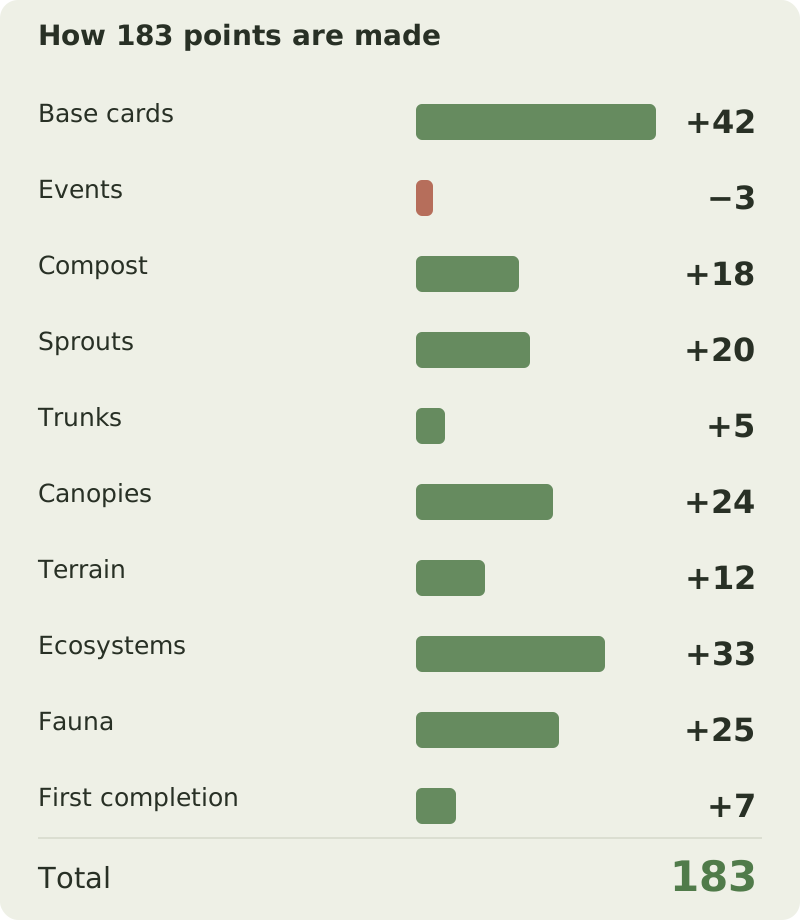
Base card VP is 42, events −3, compost 18 and sprouts 20. Incomplete trunks score 5 and completed flora total 24. Terrain bonuses score 12, Ecosystems 33 and Fauna 25. The player completed their tableau first, adding 7. The result is 42 − 3 + 18 + 20 + 5 + 24 + 12 + 33 + 25 + 7 = 183.
Transferring the island into the form
Enter compost, sprouts and incomplete trunks as component counts. Canopies, Terrain, Ecosystems and Fauna require calculated point subtotals. Set first completion to one; the form applies the seven-point multiplier. Record soil, hand size and all Growth pieces for tiebreaking. Your total Growth count cannot be smaller than the incomplete-trunk count already entered.
Beginner setup and expansions
Beginner setup keeps the main categories but changes shared objectives. Leave unused categories at zero and read Fauna values from the board side in use. Abundance adds its own elements and is not modelled here. This profile is only for competitive games with 2–5 players. Solo play against Gaia requires special scoring and result-comparison rules and is outside this calculator.
Errors that change the result
- Do not add trunks underneath a completed canopy a second time.
- Do not score a card’s base value in both the tableau and compost.
- Do not replace negative event VP with zero.
- Do not award seven points to every completed tableau.
Try it yourself
Try the example with your own numbers
Change the values to see how the score changes. This is a practice calculation; your saved game in the calculator is kept separately.
Questions & answers
Does remaining soil score points?
Not by itself. Soil is the first tiebreaker. If a card creates a separate conditional award, evaluate it using the card’s text in the appropriate category.
How are tied scores resolved?
Compare remaining soil, then hand size, all Growth pieces, sprouts and composted cards. Keep these quantities available even after the main point total has been calculated.
Sources and verification
Prepared by Board Game Scoreboard. Rules checked against the sources below on November 17, 2026; the worked example is checked during each site build. If editions differ, follow the rulebook included with your copy.
How we prepare our guidesReady to score your game?
Enter each player's results to see the total and a full breakdown.
Go to calculator ↗