Keep this handy at the table
Quick scoring reference
- Finish day five and leave the ships assembled.
- Record each separate family size without joining matching colours across gaps.
- Add rare treasures and lessons, then subtract rats and rooms.
- If scores tie, compare fish remaining in players’ supplies.
Preparing to check the ship
Begin scoring after every action of the final day has finished. Keep cats on their boats and private cards separate from public lessons. Leave your fish beside the ship: fish does not add points, but its remaining quantity can determine the winner of a tied game. Prepare a separate scoring record for each player.
Work through the boat from stern to bow and mark groups already checked. Examine one colour before moving to the next. Count the cat tiles themselves rather than the squares they cover: a large family means more animals. A single tile does not become five cats merely because of the space it occupies.
Scoring each family
A family contains at least three cats of one colour connected through edges. Corner contact does not join tiles. Two separate groups of three matching cats form two families worth eight points each. Do not record them as one group of six, even if all cats occupy the same half of the boat. Gaps and other colours do not connect them.
Families of three, four, five and six score 8, 11, 15 and 20 respectively. Every additional cat adds five points, so a family of eight scores 30. An Oshax belongs to its assigned colour, which must also be used when checking lessons. The calculator applies the family table independently to each group entered.
Treasures, lessons and two kinds of penalty
Each rare treasure tile scores three points. Common treasures score no points themselves, but help cover spaces. Read lessons individually, checking their conditions, chosen colours and scope. Record private and public lesson points separately. If a card modifies normal scoring, apply its text when preparing the appropriate subtotal, taking care not to award the same points twice.
Each visible rat costs one point. Each of the seven rooms with at least one visible square costs five, regardless of how many gaps remain. One uncovered rat square can cause both penalties. The room without a special icon still counts as a room. Follow the printed boundaries rather than relying only on the pictures within squares.
Worked example: two families and lessons
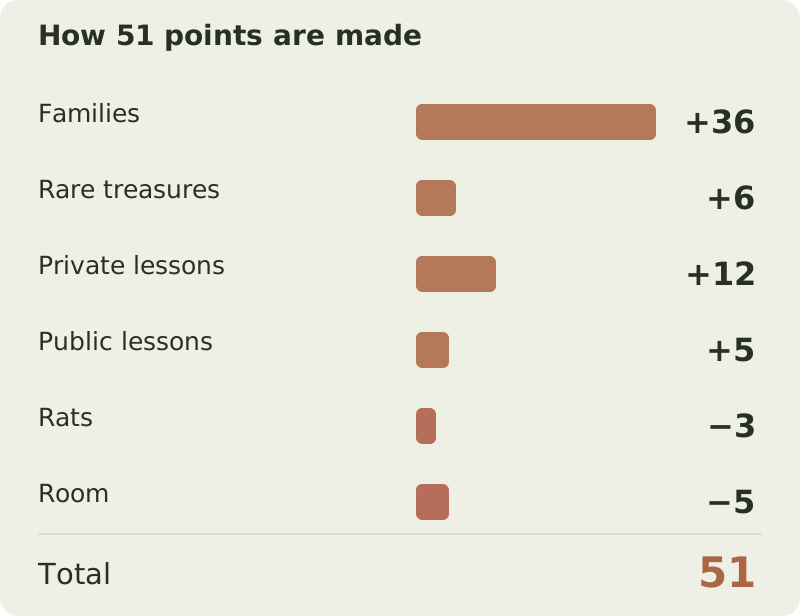
The ship has separate families of four and seven cats, scoring 11 and 25. Two rare treasures add 6, private lessons score 12 and public lessons score 5. Three rats remain visible and one room is unfilled. Start by recording every positive category: 11 + 25 + 6 + 12 + 5 = 59.
The penalties are 3 and 5, leaving 51 points. If another player also scores 51, compare fish. Filling six rooms does not create an extra award here; filled rooms simply avoid their penalties. Checking this example category by category makes a mistaken family size visible before you combine everything into the final total.
Entering the figures
Enter 4 and 7 in the first two family rows and leave the others at zero. Enter treasure count 2, lesson scores 12 and 5, rats 3 and unfilled rooms 1. Record fish for a potential tie. Do not enter the already calculated 11 points as a family size: the form would interpret that as eleven cats.
Supported rules and editions
This profile is for an ordinary competitive game for 2–4 players. Solo mode is excluded because it changes public-lesson scoring and separately scores your sister. Family cards and expansions can also change objectives and rules. In particular, a family-mode tiebreaker does not replace fish in the standard game. Standalone games in the series should use their own scoring sheets and the appropriate publisher instructions.
Checks before comparing scores
- Count animal tiles for families, not the squares those tiles occupy.
- Do not join matching colours through corners, other colours or gaps.
- Do not score common treasures as rare ones or award points for filled rooms.
- Keep fish until the winner is determined: tied point totals may still need a comparison.
Try it yourself
Try the example with your own numbers
Change the values to see how the score changes. This is a practice calculation; your saved game in the calculator is kept separately.
Questions & answers
Do assigned Oshax count?
Yes. An Oshax counts as a cat of its assigned colour, including family and applicable lesson checks. It does not provide an additional automatic bonus.
Does one empty square make a room unfilled?
Yes. Every square in the room must be covered to avoid the penalty. The size of the remaining gap does not change the normal five-point deduction.
Sources and verification
Prepared by Board Game Scoreboard. Rules checked against the sources below on November 17, 2026; the worked example is checked during each site build. If editions differ, follow the rulebook included with your copy.
How we prepare our guidesReady to score your game?
Enter each player's results to see the total and a full breakdown.
Go to calculator ↗