Keep this handy at the table
Quick scoring reference
- Finish placing the last selected dominoes.
- Divide the kingdom into edge-connected areas of matching terrain.
- For each territory separately, multiply squares by crowns.
- Break ties by largest territory, then total crowns.
When to inspect the kingdom
Score after the last selected dominoes have been placed. If a domino cannot be added legally and is discarded, neither its squares nor its crowns count. Leave the kingdom assembled until results are compared. Trace territory boundaries or work across areas from left to right so that small patches near the edge are not missed.
The ordinary kingdom fits inside a 5 × 5 square. The starting tile and castle occupy one square, leaving at most twenty-four terrain squares. The calculator checks this total limit but does not reconstruct the kingdom’s shape. Placement rules, matching terrain requirements and the permitted dimensions must be respected while building the kingdom itself.
What makes one territory
A territory is an uninterrupted area of matching terrain squares joined through edges. Corner contact does not connect them. Two forests separated by a lake or the castle can remain different territories. Colour and artwork identify terrain types, but matching types do not merge areas that are not actually connected. Use a new entry for every separate area.
One half of a domino can belong to a forest and the other to a field, so domino count is not square count. Within a territory, count each terrain square regardless of which physical tile contains it. Matching halves of one domino both count towards their connected area. The castle does not add a square to an adjacent forest or connect forests through itself.
Crowns multiply their own entire territory
Count all crowns within one territory and multiply that count by the size of that same area. Seven forest squares with three crowns score twenty-one. If a square shows two crowns, both contribute to the multiplier. Crowns in a neighbouring territory of another terrain do not help the forest, even if their pictures appear close together on the table.
A crownless territory scores zero regardless of size. Still record it because the largest crownless territory can resolve a tie. There is no general rule awarding one point per square. Nor can you multiply all kingdom squares by all kingdom crowns: that transfers multipliers between independent territories and greatly inflates the score.
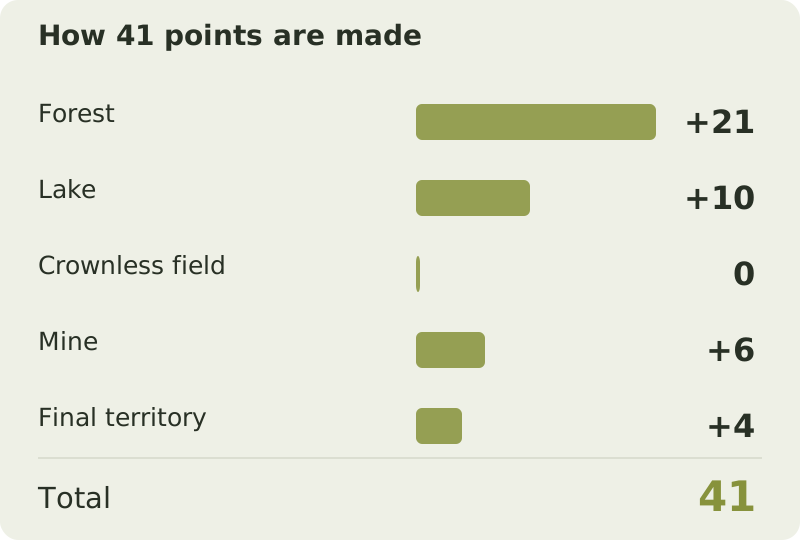
Worked example: five territories and 41 points
The kingdom has five separate territories. Seven forest squares with three crowns score 21. Five lake squares with two crowns score 10. Four field squares without crowns score 0. Two mine squares with three crowns score 6. A final four-square territory with one crown scores 4. Altogether, twenty-two terrain squares have been placed.
Add the separate results: 21 + 10 + 0 + 6 + 4 = 41. The largest territory contains seven squares and total crowns equal nine. The form derives these figures for tiebreaking. Empty spaces do not impose a separate point penalty. With optional rules disabled, castle position creates no bonus even if it lies exactly at the centre of the kingdom.
Comparing equal point totals
When scores tie, find each contender’s largest separate territory. Compare its square count, not its score and not all squares of one terrain combined. If largest territories also tie, compare total crowns in the kingdom. If the tie persists, share victory. That is why crownless entries must be retained even after their multiplication produces zero points.
Entering territories in the form
For the example, fill five pairs of entries: squares 7, 5, 4, 2, 4 and corresponding crowns 3, 2, 0, 3, 1. Leave the remaining entries at zero. Territory numbering is arbitrary and does not affect points. Keep each area’s two figures together: shifting crown counts into neighbouring rows can produce a plausible but incorrect result.
The form provides twenty-four territory entries to accommodate even a very fragmented kingdom. An unused zero row neither loses points nor needs deleting. The calculator flags crowns without squares and an excessive total land area. If it warns, first check for a duplicated territory or a domino number accidentally entered instead of its area.
Why optional bonuses are excluded
Classic optional rules can reward a central castle and a complete grid. Agree on them before play; they do not arise automatically in base scoring. This profile leaves both bonuses disabled. A 7 × 7 duel needs different area limits, while Origins and Queendomino add their own scoring sources and therefore require separate rules profiles.
Four common mistakes
- Do not join matching terrain through corners or the castle.
- Do not use domino count instead of territory square count.
- Do not transfer one territory’s crowns to another.
- Keep crownless territories because their sizes can matter in a tie.
Try it yourself
Try the example with your own numbers
Change the values to see how the score changes. This is a practice calculation; your saved game in the calculator is kept separately.
Questions & answers
Does the castle count as a square of every terrain?
No. It helps connect dominoes during construction but is not part of a scored territory and does not join two matching areas through itself.
Do gaps in the kingdom cost points?
The ordinary base formula has no separate gap penalty. Gaps reduce opportunities to score, but do not create a negative entry in the final calculation.
Sources and verification
Prepared by Board Game Scoreboard. Rules checked against the sources below on November 17, 2026; the worked example is checked during each site build. If editions differ, follow the rulebook included with your copy.
How we prepare our guidesReady to score your game?
Enter each player's results to see the total and a full breakdown.
Go to calculator ↗