Keep this handy at the table
Quick scoring reference
- Finish round nine scoring, including ingredient effects.
- If your pot exploded, first choose its available reward: VP or buying power.
- Every complete pair of rubies scores 1 point.
- Every complete group of 5 available final-round coins scores 1 point.
The three values needed at game end
Keep your pot, rubies and score marker in place after the final brew. First finish normal round nine evaluation: ingredient bonuses, ruby collection and eligible rewards. Calculate the final conversion separately afterward.
You need the track score after normal awards, remaining rubies and available final-round money. Money means this round's pot buying power, rather than savings across the game. Unspent buying power from earlier rounds does not carry into the final conversion.
Check whether your score marker passed 50 using the relevant tile. A marker at 17 after one lap means 67, not 17. Use the full score as your starting value.
Determining your final pot reward
The scoring space is the empty space immediately after your last ingredient. Read ordinary VP and buying power from that space. The number on the last ingredient determines its movement, rather than replacing the scoring space's value.
If your pot did not explode, you receive normal points and can use the money. After an explosion, the English rules covered here require choosing one reward. You cannot take the pot's points and then convert all its buying power as though it had not exploded.
Rubies and ingredient effects have their own evaluation steps. An explosion does not erase your ruby supply or the points earned over the previous eight rounds. Resolve eligible effects in order, then perform the final conversion.
Converting rubies and coins into points
Group rubies into pairs. Each complete pair scores 1 VP: five rubies score 2, leaving one unscored. Group available money into fives: 27 coins score 5 VP, with 2 left over.
Do not combine leftovers across resources. One ruby and three coins cannot buy a point together because each resource uses its own rate. Never round upward.
| What remains | Conversion | Example |
|---|---|---|
| Rubies | 2 rubies → 1 VP | 5 rubies → 2 VP |
| Available round nine money | 5 coins → 1 VP | 27 coins → 5 VP |
| Incomplete remainder | No points | 1 ruby and 2 coins → 0 VP |
Worked example: from 67 to 74 points
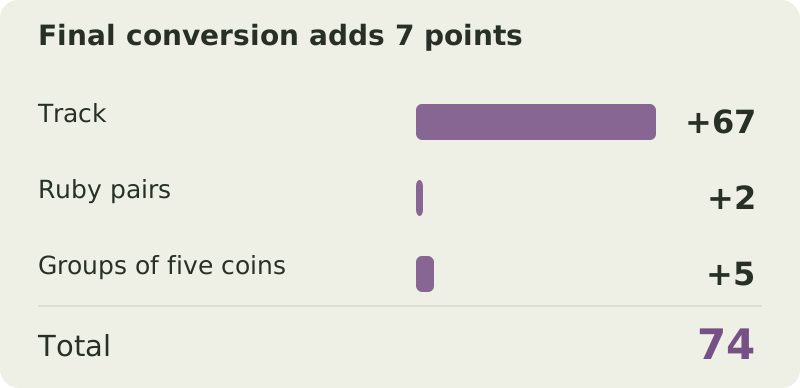
Ella's pot did not explode. After normal round nine scoring, she has 67 on the track, 5 rubies and 27 available coins. Ordinary pot points are already included in 67 and must not be added again.
Five rubies form two pairs, worth 2 VP. The 27 coins form five complete groups of five, worth 5 VP. The final addition is 7, for a score of 74. The diagram shows this final arithmetic, rather than recalculating all nine brews.
| Category | Calculation | Points |
|---|---|---|
| Track after round nine | All normal awards already included | 67 |
| Rubies | 5 ÷ 2: two complete pairs | 2 |
| Money | 27 ÷ 5: five complete groups | 5 |
Work it out67 + 2 + 5 = 74 points
Worked example: choosing after an explosion
A player has 61 points before the final pot reward; the pot offers 6 VP or 27 coins, and they have 5 rubies. Without other effects, choosing VP gives 61 + 6 + 2 = 69. Choosing money under the English rules gives 61 + 5 + 2 = 68.
For the first option, enter zero money because the player chose points. For the second, leave the pot's 6 VP out of the track score because they were declined. The calculator cannot detect an explosion or know your choice; you provide the eligible values.
Who wins a tied score?
Compare final points after conversion. A tie goes to the player whose pot progressed furthest in the final round. Keep the last ingredient in place until rankings are settled.
If pot progress is also tied, share the victory. The price of the last bought ingredient and the total of white chips are not further tiebreakers.
Entering the example in the calculator
For Ella, enter Score track 67, Remaining rubies 5 and Final-round coins 27 to get 74. Enter actual rubies and money, rather than the 2 and 5 points they earn: conversion is automatic.
Enter the final pot position for ties. If you already moved your marker for conversion, either restore the pre-conversion track score and enter leftovers, or enter the finished score with both conversion fields at zero. Otherwise rubies and money score twice.
Rule editions and expansions
The Schmidt Spiele 2024 English booklet describes final conversion as buying VP for 5 coins or 2 rubies; after an explosion, the choice between normal VP and buying still applies. The explanation above follows that edition.
The 2018 German rules explicitly restrict final-round money conversion to pots that did not explode. If you play that edition, follow its restriction and enter no conversion money after an explosion. Identical components do not remove differences in the text.
Ingredient book sets change individual chip effects. Expansions may add final rewards and exceptions. Resolve these with their rulebook and include points already awarded in the track total. The calculator does not model witches, patients or other special components.
Common mistakes
- Adding money from all nine rounds. Only eligible final-round money is converted.
- Taking pot points and fully converting its money after a normal explosion. Apply your edition's choice rule first.
- Entering calculated points under rubies. Enter the number of rubies themselves.
- Rounding 27 ÷ 5 to 6. There are only five complete groups.
- Reading points from the last ingredient. Ordinary scoring uses the space after it.
Try it yourself
Try the example with your own numbers
Change the values to see how the score changes. This is a practice calculation; your saved game in the calculator is kept separately.
Questions & answers
How many points do 7 rubies score?
3 points from three complete pairs. One ruby remains unscored.
Can I convert money from earlier rounds?
No. Earlier buying power does not accumulate. Use only eligible money from round nine.
Do I need to recount every ingredient in my bag?
No. The final calculator uses track points, remaining rubies and available money. Resolve special ingredient effects using their books first.
Sources and verification
Prepared by Board Game Scoreboard. Rules checked against the sources below on November 17, 2026; the worked example is checked during each site build. If editions differ, follow the rulebook included with your copy.
How we prepare our guidesReady to score your game?
Enter each player's results to see the total and a full breakdown.
Go to calculator ↗