Keep this handy at the table
Quick scoring reference
- Finish the last harvest and feeding, then keep the farm intact.
- Count each animal type, dogs, and crops both on fields and in supply.
- Add printed furnishing points and conditional bonuses separately.
- Check all three penalty categories and the Writing chamber.
When to record the farm
Score after the final required harvest and feeding. Resources spent to feed your dwarfs are no longer in your supply and cannot also score at the end. If a particular furnishing permits exchanges before scoring, finish those exchanges before recording the final quantities.
Keep the cave and forest assembled until you check penalties. Work across the home board from left to right, identifying used spaces, then check your supply separately. This distinguishes two different questions: which components you own and which spaces on your home board remain unused.
Animals and missing types
Each sheep, donkey, wild boar and cattle scores one point. Each dog also scores one, although dogs are not farm animals for various furnishing effects. Do not score the capacity of a pasture: points come from animals actually present, not from spaces that could accommodate a future herd.
Subtract two points for each missing type among the four farm animals. Sheep, donkeys and cattle with no wild boar mean a single penalty of −2. Having no dogs costs nothing. A large flock of sheep does not replace a missing boar: this category checks variety, not the overall size of your herd.
Crops and other positive categories
Combine all grain in your supply and on fields, divide by two and round up once. Five grain scores three points, six also scores three, and seven scores four. Do not round fields and supply separately: two odd subtotals could incorrectly create an extra point.
Each vegetable, ruby and dwarf scores one point. Count gold coins by their total value. Add printed furnishing, pasture and mine points, followed by conditional bonuses from yellow furnishings. Check each furnishing’s own condition; its bonus does not replace the normal points for the animals or crops it rewards.
Unused spaces, begging and the Writing chamber
Each unused home-board space costs one point. An excavated cavern is already used even without a furnishing, and the starting caverns are not unused spaces. Each begging marker costs three points, regardless of the round in which you received it.
The Writing chamber prevents at most seven points of combined penalties for missing animals, unused spaces and begging. If those penalties total four, it prevents four rather than awarding seven free points. The calculator displays the prevented loss as a separate positive contribution while retaining the original penalty lines for checking.
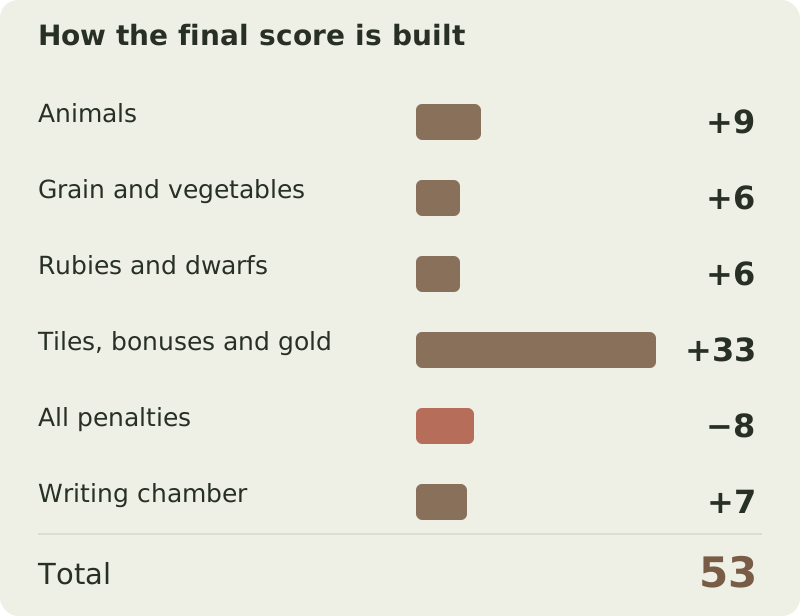
Example: a farm worth 53 points
The player owns four sheep, one donkey, two cattle and two dogs, but no wild boar. Animals score nine and the missing type costs two. Five grain scores three, three vegetables score three, two rubies score two and four dwarfs score four. Tiles contribute 20, conditional bonuses 6 and gold 7.
Three unused spaces and one begging marker cost a further three points each. The three penalty categories therefore total eight points. The owned Writing chamber prevents seven of those eight. The final calculation is 9 − 2 + 3 + 3 + 2 + 4 + 20 + 6 + 7 − 3 − 3 + 7 = 53.
What to enter
Enter five grain in the example, not the three points it scores. Similarly, enter one begging marker rather than its three-point penalty. The printed-tile and conditional-bonus fields instead require already calculated point totals. Each field’s hint identifies whether it expects components or points.
Base game and expansions
This profile is for the standard base-game farm. Do not import Agricola’s rules: animal and grain scoring are different here. Expansions can alter faction abilities and tile scoring, so check their own rules. In base Caverna, tied final scores share victory; there is no extra resource tie-breaker.
What is easy to miss
- Do not penalize having no dogs or include dogs in bonuses requiring farm animals.
- Do not treat an unfurnished cavern as an unused space.
- Do not add the Writing chamber’s prevented penalty again as a conditional bonus.
Try it yourself
Try the example with your own numbers
Change the values to see how the score changes. This is a practice calculation; your saved game in the calculator is kept separately.
Questions & answers
Does five grain score two or three?
Three. Combine all grain first, then halve the total and round up.
Are dogs one of the four required types?
No. The required types are sheep, donkeys, wild boar and cattle. Each dog still scores one point.
Sources and verification
Prepared by Board Game Scoreboard. Rules checked against the sources below on November 17, 2026; the worked example is checked during each site build. If editions differ, follow the rulebook included with your copy.
How we prepare our guidesReady to score your game?
Enter each player's results to see the total and a full breakdown.
Go to calculator ↗