Keep this handy at the table
Quick scoring reference
- Finish the final turns and gather cards from your hand and personal discard.
- Count houses by goods, occupied provinces and colonists; sort personality cards by god.
- Value cash and stored goods for Vesta, then apply the other gods’ multipliers.
- Add specialists and the ending card; use Praefectus Magnus to resolve a tie.
Prepare the final position
Buying the last personality card from the display or building your fifteenth house triggers the ending, but does not immediately freeze every player’s position. The other players still take a final turn. Their goods, houses and purchased cards can change, so wait until those turns are finished before scoring.
Gather all your personality cards, including those in your personal discard pile. A card contributes to final scoring whether or not you played it during the last cycle. Sort by the god printed at the bottom, rather than by the action title: similar actions can belong to different scoring categories.
Vesta: cash and stored goods
First value stored goods: bricks are worth 3 sestertii, food 4, tools 5, wine 6 and cloth 7. Add your cash. Divide that combined value by ten and discard the remainder. Do not round each type separately: small remainders from different goods can combine into another complete group of ten.
Houses are not stored goods. A house in a wine city can help Mercurius and other gods, but does not mean you have wine in your storehouse. Conversely, stored cloth can score through Vesta even if you have no house in a city that produces cloth.
How the other god multipliers work
Jupiter awards one point per house outside brick cities, multiplied by your number of Jupiter cards. Saturnus uses the number of provinces containing at least one of your houses. Two houses in one province can help other categories, but they do not create a second province for Saturnus.
Mercurius gives two points for each type of good produced by your houses. Five different goods are worth ten points per card, regardless of how many duplicate houses you own. Mars gives two points for each of your colonists on the game board. Colonists still in your storehouse do not count.
Minerva is linked to specialists for specific goods. The Mason, Farmer and Smith give 3 points per matching house, the Vintner gives 4 and the Weaver gives 5. Score each specialist separately. One house can help Jupiter, Saturnus, Mercurius and its specialist simultaneously: these are intentionally separate scoring categories.
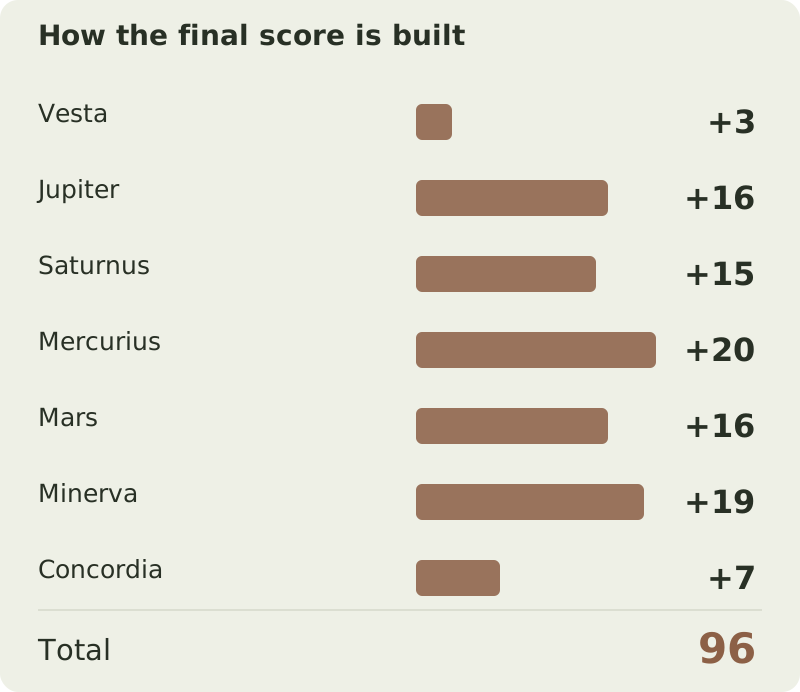
Example: ten houses and 96 points
The player has two brick houses, three food houses, two tool houses, one wine house and two cloth houses. They occupy five provinces and have four colonists on the board. Their cards include two Jupiter, three Saturnus, two Mercurius and two Mars cards, plus a Farmer, Weaver and the Concordia card.
Their supply contains 17 sestertii, one food, two tools and one cloth: total wealth of 38 gives 3 Vesta points. They then score 16 for Jupiter, 15 for Saturnus, 20 for Mercurius, 16 for Mars, 19 for specialists and 7 for ending the game. The total is 96.
Enter your position in the calculator
Enter quantities of goods and houses, rather than points you have already multiplied. For example, enter 3 in Food · houses and 1 in Food · Minerva cards. The calculator derives the eight non-brick houses, five production types and correct specialist values from those quantities.
For tied scores, priority goes to the holder of Praefectus Magnus, or the tied player who would receive it next clockwise. Give an earlier eligible recipient a higher tie-priority number. This number adds no victory points and never replaces the actual final score.
Scope of the base profile
Venus introduces its own scoring god and team-play considerations; Salsa adds further effects. Those rules cannot be silently absorbed into the base-game total. Use the expansion’s own scoring reference for such games. The practice example below is specifically for the base game and does not overwrite your main calculator session.
Common mistakes
- Forgetting the personal discard pile: those cards score alongside cards in hand.
- Counting brick-city houses for Jupiter: those houses are excluded.
- Using stored goods for Mercurius instead of the diversity of production cities.
- Giving everyone 7 points: only the player who triggered the ending owns Concordia.
Try it yourself
Try the example with your own numbers
Change the values to see how the score changes. This is a practice calculation; your saved game in the calculator is kept separately.
Questions & answers
Do all personality cards score?
Yes. Score all personality cards you own, from both hand and personal discard, grouped by their gods.
Does money score separately from Vesta?
No. Combine cash with the value of stored goods and convert complete groups of ten into Vesta points.
Can one house score more than once?
Yes. One house can legitimately contribute to several different gods’ scoring categories.
Sources and verification
Prepared by Board Game Scoreboard. Rules checked against the sources below on November 17, 2026; the worked example is checked during each site build. If editions differ, follow the rulebook included with your copy.
How we prepare our guidesReady to score your game?
Enter each player's results to see the total and a full breakdown.
Go to calculator ↗