Keep this handy at the table
Quick scoring reference
- Combine your hand, deck and discard pile, plus any other cards you own.
- Estates score 1, Duchies 3 and Provinces 6; each Curse subtracts 1.
- For Gardens, divide total deck size by 10, round down and multiply by your number of Gardens.
- Add special expansion points. Use turns taken to break ties.
Gather all your cards first
Scoring begins after the game ends. Buying the last Province does not interrupt the current turn. Base-game ending conditions are checked at turn end: the Province pile is empty or any three Supply piles are empty. Players do not finish the round back to the first player, so turn counts may differ.
Gather your hand, deck and discard pile. A card in your discard scores just as it would in your hand. Check expansion cards set aside under their own rules. Cards in the Supply or trash are not yours.
Sort cards by name. Separate Estates, Duchies, Provinces, Curses and Gardens if used. Keep other cards nearby for the deck count. This order makes it easier to verify the result without sorting everything again.
Which cards score points?
Green artwork helps identify Victory cards, but printed values and card text determine scoring. Coin cost is not victory points. Ordinary Copper, Silver and Gold do not become points at game end.
Record each card pile's count and multiply by its per-card value. Keep Curses on a separate negative line so the deduction is visible and easy to compare with the calculator.
| Cards | Manual calculation |
|---|---|
| Estates | Count × 1 |
| Duchies | Count × 3 |
| Provinces | Count × 6 |
| Curses | Count × −1 |
| Gardens | Gardens count × complete sets of ten owned cards |
| Special cards and tokens | Follow the relevant expansion's text |
Scoring Gardens without rounding up
Deck size means every card you own, not just the face-down draw pile. Include Gardens themselves, Victory cards, Treasures, Actions and Curses. Count complete tens: 29 cards contain two; 30 contain three.
With three Gardens and 29 cards in total, each Gardens is worth 2, for 6 combined. At 30 cards, those same three Gardens score 9. Check that one Gardens has a whole-number value and every Gardens owned by the same player scores equally.
Do not remove Curses before counting deck size: each has two effects. It subtracts a point while still counting as a card for Gardens. These effects apply together.
A complete worked example
Consider a 29-card kingdom with 3 Estates, 2 Duchies, 4 Provinces, 2 Curses and 3 Gardens. The other 15 cards are ordinary Actions and Treasures without their own VP.
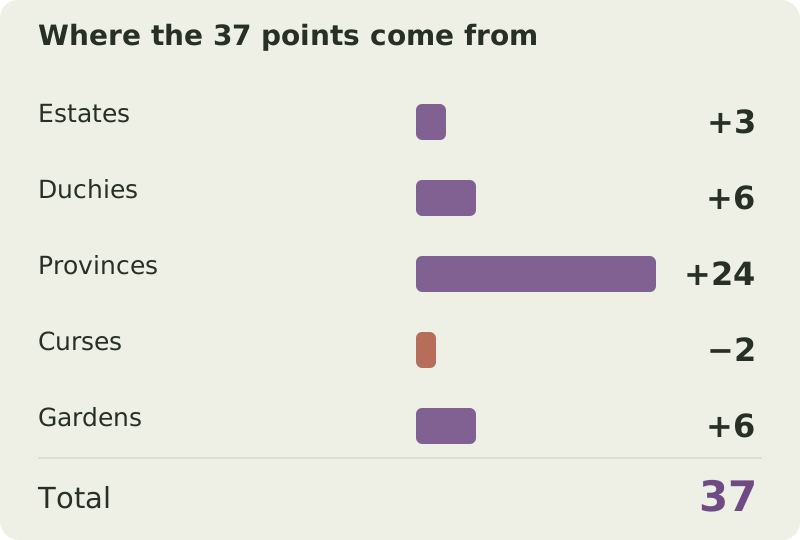
Standard Victory cards score 3 + 6 + 24 = 33. Subtract 2 Curses to get 31. There are two complete tens in 29 cards, so three Gardens add 6. The final score is 37.
Each category has its own table row below. If your answer differs from the calculator, compare categories, starting with deck size and Gardens count: this is where card counts are easily confused with points.
| Category | Calculation | Points |
|---|---|---|
| Estates | 3 × 1 | 3 |
| Duchies | 2 × 3 | 6 |
| Provinces | 4 × 6 | 24 |
| Curses | 2 × −1 | −2 |
| Gardens | 3 × 2 complete tens | 6 |
| Total | Sum of categories | 37 |
Work it out3 + 6 + 24 − 2 + 6 = 37 points
Using the Dominion calculator
Enter card counts for Estates, Duchies, Provinces and Curses: 3, 2, 4 and 2 here. Enter Gardens 3 and Deck size 29. The calculator multiplies values and subtracts penalties automatically.
Other cards and tokens takes a calculated expansion point total. If special effects award 8 in total, enter 8 once. Do not include Provinces or Gardens there again.
Enter turns taken to resolve tied scores. This value adds no points. Each row represents one player; row order does not decide the winner.
Editions, expansions and ties
Estate, Duchy, Province and Curse values are shared by both editions. Available Kingdom cards differ, so check variable effects on your own cards. The calculator does not reconstruct purchases or played Actions.
Points ties favor the player who took fewer turns. If turns are also tied, share the victory. Deck size and remaining coins are not substitute tiebreakers.
Expansions may introduce VP tokens, additional Victory cards and end-game effects. Calculate these separately under their rules, then add the total. Do not automatically carry expansion ending conditions or special scoring into a base game.
Common scoring mistakes
- Counting only the draw pile. Include your hand and discard to avoid missing Victory cards and changing Gardens values.
- Confusing a Province's price with its points. It costs 8 coins but scores 6 VP.
- Rounding deck size upward. A 29-card deck contains only two complete tens.
- Entering a negative Curse count. Enter a positive quantity; the calculator subtracts it.
- Adding special points twice. Give each award one category and check it is not already in another subtotal.
Try it yourself
Try the example with your own numbers
Change the values to see how the score changes. This is a practice calculation; your saved game in the calculator is kept separately.
Questions & answers
Do cards in hand and discard score?
Yes. Count all cards you own regardless of location. Supply and trashed cards are not yours.
Do Gardens count toward deck size themselves?
Yes. Count every card you own, including Gardens and Curses.
Should I convert Treasures into victory points?
Ordinary base-game Treasures do not score. Special expansion cards follow their own text.
Sources and verification
Prepared by Board Game Scoreboard. Rules checked against the sources below on November 17, 2026; the worked example is checked during each site build. If editions differ, follow the rulebook included with your copy.
- Dominion — official Rio Grande Games Second Edition rules ↗
- Dominion — publisher's game and rules page ↗
Ready to score your game?
Enter each player's results to see the total and a full breakdown.
Go to calculator ↗