Keep this handy at the table
Quick scoring reference
- Lay out your hand and declare all permitted transformations.
- Clear applicable penalties, then determine which cards are blanked.
- Record each active card’s base strength, bonus and remaining penalty.
- Add the card results; break a tied total using combined base strength.
Prepare the hand before scoring
Keep the actual final hand rather than the cards you held one turn earlier. A normal hand contains seven cards. Some effects permit an additional card; the eighth score-sheet row accommodates that exception and does not itself allow you to take one. Do not add the discard area or other players’ hands to your score.
Keep your edition’s rules nearby and leave the cards visible until the score has been checked. Arrange them in the same order as the form’s rows. Another player can then trace each number back to its card, rather than trying to reconstruct the entire combination from memory after the hand has been collected.
Resolve effects in the correct order
First decide what the special cards copy, following the rulebook’s order: Doppelgänger, Mirage and Shapeshifter. Then apply the Book of Changes. Changing a suit does not rewrite every property of the card. In particular, the Book of Changes does not change its name, base strength, bonus or penalty. That distinction matters when an effect names a particular card.
After these declarations, apply penalty-clearing effects and then the penalties themselves. In an interaction chain, do not simply read left to right and immediately remove every affected card. A clearing effect already resolved can matter to the chain’s outcome. When an interaction is unclear, settle it using the official examples and questions before entering numbers.
Clearing a penalty is different from blanking
Clearing a numerical penalty leaves the card active, so its base strength and applicable bonuses still count. In that row’s penalty field, enter only the amount remaining after all clearing effects. Enter zero if the penalty is fully cleared. Avoid subtracting the old penalty and then adding a separate refund, which makes double adjustments easy.
A blanked card has no suit, base strength, bonus or penalty for scoring. Mark it as blanked and the calculator zeros the entire row, even if numbers remain in its fields. Evaluate other cards’ conditions against the resolved hand. A physical card still lying on the table is not necessarily an active card of the suit another effect requires.
Worked score-sheet example: 83 points
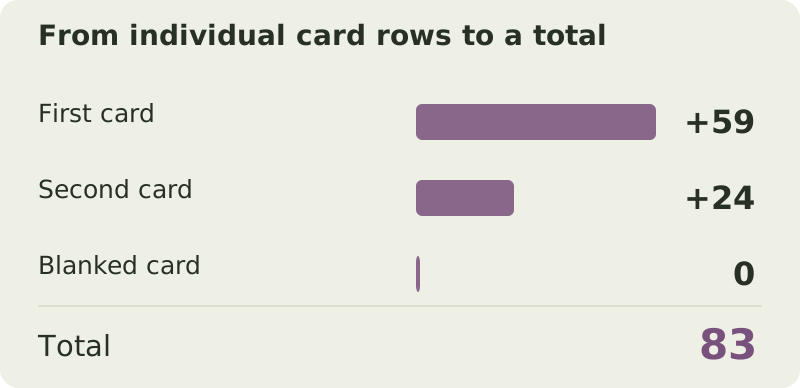
Consider an arithmetic example after the effects have been resolved manually. The first active card has base strength 9 and a bonus of 50. The second has strength 13, a bonus of 15 and a penalty of 4. A third card has strength 32 but is blanked. The other rows are empty: this demonstrates individual score-sheet rows rather than a legal complete hand.
The first row scores 59, the second 24 and the third zero, for a total of 83. Removing the third row’s blanking would add 32. Clearing only the second card’s penalty would instead add 4. This comparison shows why blanking and clearing cannot safely be represented by the same generic negative adjustment.
Work it out9 + 50 + 13 + 15 − 4 + 0 = 83 points
Fill in the calculator
Each card has four controls: base strength, total active bonuses, uncleared numerical penalty entered positively, and blanking status. The first example row uses 9, 50, 0 and active. The second uses 13, 15, 4 and active. Enter 32 for the third row and select blanked.
The form does not know which cards you hold and does not verify that a bonus matches your combination. Its purpose is to preserve separate rows, subtract penalties correctly, zero blanked cards and display the total. Do not enter a card’s already calculated final value as base strength while also entering the bonuses used to obtain it.
Break a tied total
If total scores are tied, the hand with the lower combined base strength wins. Bonuses and numerical penalties do not enter this comparison. Ignore blanked cards because they have no active base strength. Keeping the original values in separate rows therefore helps with the second comparison without requiring the full arithmetic to be reconstructed.
Editions and expansions
This guide uses the base deck and effect-resolution order in the WizKids rules. The two-player variant changes setup and the end condition rather than the fundamental arithmetic of a card. Expansions introducing new suits, items or additional scoring sources are not automatically supported: check whether all categories in your game fit this base score sheet before using it.
Common scoring mistakes
- Confusing a cleared penalty with a completely blanked card. The former keeps its strength and bonuses.
- Repeating a “with” bonus for several matching cards: distinguish “with” from “for each.”
- Adding bonuses for opponents’ matching cards instead of your own hand.
- Treating the eighth row as permission to always hold eight cards.
Try it yourself
Try the example with your own numbers
Change the values to see how the score changes. This is a practice calculation; your saved game in the calculator is kept separately.
Questions & answers
Does the calculator choose the best Mirage transformation?
No. Declare the transformation and resolve its consequences using the rules, then enter the resulting strength, bonuses, penalties and blanking status.
Where do I enter a completely cleared penalty?
Enter zero in the penalty field. Do not blank the entire card because its penalty was cleared; its other properties remain active.
Sources and verification
Prepared by Board Game Scoreboard. Rules checked against the sources below on November 17, 2026; the worked example is checked during each site build. If editions differ, follow the rulebook included with your copy.
How we prepare our guidesReady to score your game?
Enter each player's results to see the total and a full breakdown.
Go to calculator ↗