Keep this handy at the table
Quick scoring reference
- Stop as soon as the third Winter card appears and preserve the final forest.
- Count only visible card halves and scoring conditions that are met.
- Enter separate quantities for European Hares, Red Foxes, Wolves and cards showing the deer symbol.
- Add the other categories and cave cards without counting separately entered animals twice.
When to score the final forest
The third Winter card ends the game immediately. Do not continue the unfinished turn or add a card you were merely planning to play. Leave all trees and attached halves in place. Some scoring conditions depend on more than the number of inhabitants: they can refer to a specific tree, a shared slot or the composition of the entire forest.
Distinguish three areas first: the forest in front of you, your hand and the cards beneath your cave. Your hand does not score. A covered half of a played card is not a second inhabitant just because you remember what it shows. Cave cards form a separate collection that is easiest to count after checking the visible forest.
Check trees and conditional cards
Check each tree individually and read its scoring condition. Some provide fixed points; others depend on the number of trees, species diversity or cards attached to that particular tree. A single overall tree count cannot replace those checks. Where a condition compares forests, first agree on which quantities are being compared and then determine your card’s value.
Use the same approach for animals with placement requirements, butterfly sets, amphibians and other plants. A card symbol and a species name can define different conditions. Do not copy a score from the rulebook’s example onto a similar but different forest. Enter a tree subtotal and separate subtotals for other inhabitants and plants so the result remains easy to audit.
Which connections are calculated automatically
Each European Hare scores as many points as there are European Hares in your forest. Their combined score is therefore the quantity squared: four Hares score 16. Several Hares sharing a single tree slot do not count as a single card. Count every visible card of that species throughout your forest.
Each Red Fox scores two points per European Hare. Each Wolf scores five points per card showing the deer symbol. Two Wolves and three deer therefore score 30 for the Wolves. The deer cards still have their own scoring conditions: evaluate them and include their points under other inhabitants rather than treating the Wolf bonus as their score.
Worked example: a 115-point forest
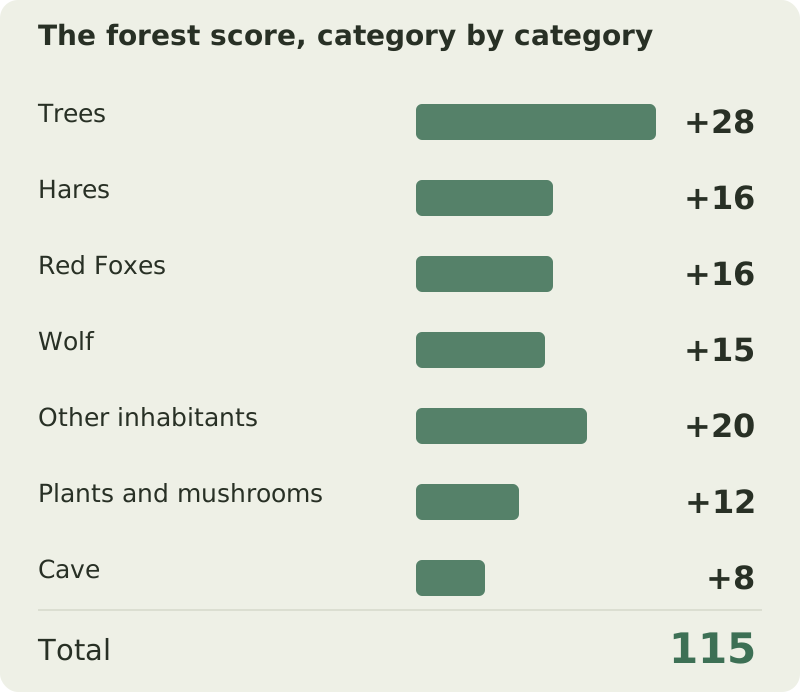
Suppose the trees score 28 after their conditions are checked. The forest contains four Hares, two Red Foxes, one Wolf and three deer-symbol cards. Other animals, including those deer, score 20. Plants and mushrooms score 12, and eight cards lie beneath the cave. Each category records the cards’ own points without duplicating another category.
The Hares score 4 × 4 = 16, the Foxes 2 × 4 × 2 = 16, and the Wolf 1 × 3 × 5 = 15. The cave adds 8. Including the calculated categories gives 115. Finding a fifth Hare would change both the Hare group and both Foxes, illustrating why these connected multipliers are useful to calculate automatically.
Work it out28 + 16 + 16 + 15 + 20 + 12 + 8 = 115 points
What to enter in the form
Enter calculated victory points for trees, other inhabitants, and plants and mushrooms. Enter card quantities for Hares, Red Foxes, Wolves, deer-symbol cards and the cave. The example uses 28; then 4, 2, 1, 3; then 20, 12 and 8. The deer field supplies the Wolf multiplier and does not itself award the deer cards’ points.
Do not include Hares, Red Foxes or Wolves again under other inhabitants. If you already scored the entire forest on paper, separate it into these categories first. Entering the total for all animals under other inhabitants while also filling the automatic animal fields would count them twice. Open the breakdown and compare it with the corresponding card groups on the table.
The base game and an expanded forest
This profile is for the base deck. Expansions and promo cards can change which species qualify and how existing interactions work. They cannot be included simply by increasing a familiar field’s quantity. For example, a new Hare species first requires checking whether it counts as a European Hare for the particular effect. Follow your edition’s text and the publisher’s clarifications.
In the base game, equal totals mean a shared victory. Neither hand size nor the number of trees is an additional tiebreaker in this profile. Keeping the separate categories across repeat games can help you see whether an improved result came from trees, animal combinations or a larger collection of cave cards.
Common scoring mistakes
- Counting covered halves or cards in hand as part of the forest.
- Entering calculated Hare points instead of their quantity and squaring that number again.
- Forgetting the deer cards’ own points after calculating the Wolves.
- Including automatically scored animals again in another subtotal.
Try it yourself
Try the example with your own numbers
Change the values to see how the score changes. This is a practice calculation; your saved game in the calculator is kept separately.
Questions & answers
How much do four European Hares score?
The Hares themselves score 16. Any Red Foxes are scored separately using the same Hare quantity.
Are the deer cards already scored by the Wolf field?
No. That field only determines the Wolves’ points. Include the deer cards’ own scores in the calculated other-inhabitants subtotal.
Sources and verification
Prepared by Board Game Scoreboard. Rules checked against the sources below on November 17, 2026; the worked example is checked during each site build. If editions differ, follow the rulebook included with your copy.
How we prepare our guidesReady to score your game?
Enter each player's results to see the total and a full breakdown.
Go to calculator ↗