Keep this handy at the table
Quick scoring reference
- Count remaining coins and the collected meeples in the two scoring colors.
- Compare Viziers with every opponent and separately add printed Djinn VP.
- Check Tiles bearing your Camels and buildings located on those Tiles only.
- Enter remaining merchandise by type, excluding sold cards and Fakirs.
Keep the scoring components on the table
Do not remove Camels from the board before checking every territorial category. They identify the owner of each Tile for final scoring. Sort coins by denomination, collected Viziers and Elders by color, and remaining merchandise by type. This arrangement lets you check each category independently without reconstructing the history of individual turns and purchases.
Only components you still possess enter final scoring. Spent coins are not returned, spent Elders do not reappear, and sold merchandise is no longer a set in your possession. If part of the final score has already been noted on paper, use those notes as a check rather than adding them as an extra category on top of a fresh count.
Coins, Viziers and Elders
Every Gold Coin scores one point. Count denominations: five coins worth five each score 25, not five. Each yellow Vizier normally scores one point. You also gain ten for each individual opponent who has strictly fewer Viziers. Equal quantities do not create a majority bonus for either side of that comparison.
With three players, six Viziers against four and six score six ordinary points and one ten-point bonus. This is not a single prize reserved for the overall leader: a second-place player may also beat the third-place player. White Elders normally score two each. Calculate Djinn changes to these normal values separately and enter only the difference as an adjustment.
Tiles, Palm Trees, Palaces and Djinns
Add the printed values of all Tiles marked with your Camels. Then count Palm Trees and Palaces on those same Tiles. A normal Palm Tree scores three points and a Palace five. Buildings on somebody else’s territory are not yours merely because you placed them earlier. Printed Tile points remain a separate contribution: territories and buildings are distinct scoring categories.
For Djinns, enter the total victory points printed on their cards. Ongoing effects may already be reflected in other resources or may change normal component values. Do not add the entire replacement value again. If an ability increases the value of several Palm Trees, the adjustment is only the extra amount beyond the three points each already awarded by the normal formula.
Build merchandise sets
A single set contains only different merchandise types. Sets of one through nine types score 1, 3, 7, 13, 21, 30, 40, 50 or 60 points respectively. A duplicate type belongs to another set. A convenient manual method is to take one card of every available type, then repeat with the remaining cards until none are left.
For example, three Fish, two Wheat and one Pottery form a three-type set, a two-type set and one remaining Fish. The result is 7 + 3 + 1 = 11. The calculator performs this grouping from the quantities of the nine merchandise types. Fakirs do not belong in merchandise sets. Sold cards already produced coins and must not be entered here.
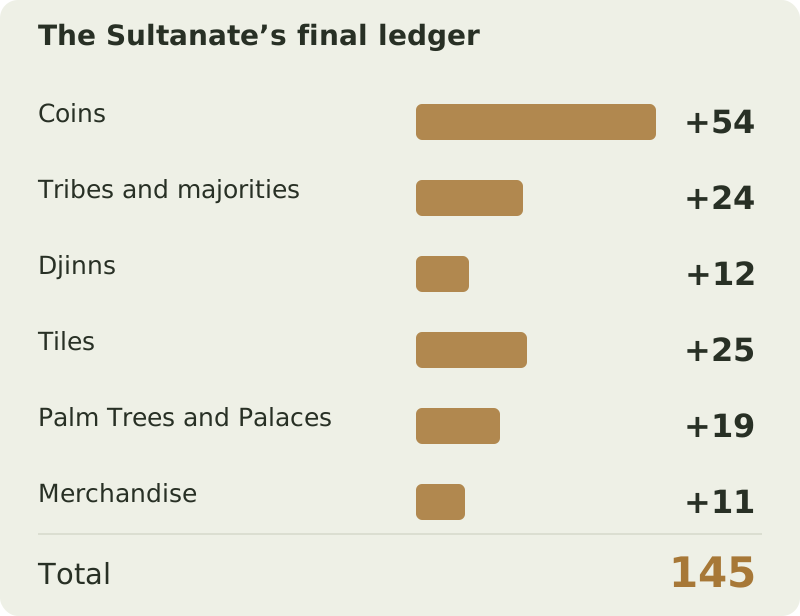
Worked final score: 145 points
Anna has 54 coins, six Viziers and four Elders. Her opponents have four and six Viziers, so her majority bonus is ten. Printed Djinn values total 12 and her Tiles total 25. Her territory contains three Palm Trees and two Palaces. Her remaining merchandise is three Fish, two Wheat and one Pottery. No ability changes the scoring rates in this example.
The tribes contribute 6 + 10 + 8 = 24. Palm Trees and Palaces add 9 + 10 = 19, and merchandise adds 11. Combined with the other categories, the total is 145. If the second opponent had five Viziers instead of six, Anna would gain ten more without changing the number of Viziers she owns.
Work it out54 + 6 + 10 + 8 + 12 + 25 + 9 + 10 + 11 = 145 points
Fill in the calculator without double counting
Enter quantities for coins, meeples, Palm Trees, Palaces and each merchandise type. Enter calculated points for Tiles and printed Djinn values. Fill in every player, particularly the yellow meeples, because those quantities determine Vizier comparisons. If opponents’ inputs are still empty, the provisional majority bonus does not yet represent the actual game.
If the total differs from your manual count, first check whether quantities and calculated VP were mixed. Next confirm that buildings sit on your Tiles and entered merchandise has not been sold. A Djinn adjustment may be negative when a verified situation requires it. Normal scoring remains visible in the breakdown, so the separate adjustment must explain only the difference from those normal values.
Expansions and tied totals
This profile covers the base Sultanate and its nine merchandise types. Expansions add categories, components and abilities, so this sheet is not presented as universal across the series. Check the rules of your own box first. Equal final scores in the base game share the victory: do not invent an extra money tiebreaker, because coins have already been counted as points.
Common scoring mistakes
- Awarding Vizier majority only to the overall leader instead of comparing each opponent.
- Treating Fakirs as a tenth merchandise type.
- Scoring sold merchandise again in addition to the coins received.
- Entering the entire modified component value as an adjustment rather than only the difference.
Try it yourself
Try the example with your own numbers
Change the values to see how the score changes. This is a practice calculation; your saved game in the calculator is kept separately.
Three players: Boris has 4 Viziers and Vera has 6. Opponents’ values remain fixed.
Questions & answers
Can the player with the second-most Viziers earn a bonus?
Yes, ten for each opponent with strictly fewer Viziers. Overall first place is not required.
Why enter each merchandise type separately?
A set’s value depends on its distinct types rather than its total cards. Separate quantities allow all sets to be grouped automatically.
Sources and verification
Prepared by Board Game Scoreboard. Rules checked against the sources below on November 17, 2026; the worked example is checked during each site build. If editions differ, follow the rulebook included with your copy.
How we prepare our guidesReady to score your game?
Enter each player's results to see the total and a full breakdown.
Go to calculator ↗