Keep this handy at the table
Quick scoring reference
- Complete round seven and its Emperor Scoring.
- Count occupied rooms only, separated by the four floors.
- Score played end-game staff and remaining krones plus kitchen items.
- Subtract five per remaining guest; compare reserves if scores tie.
Which starting score to use
First finish round seven, including its final Emperor Scoring and all associated rewards or penalties. The score after those events is the starting point for final scoring. Staff that scored during play has already moved your marker; those earlier points stay on the track and are not awarded again simply because the card remains in play.
Keep the hotel, staff, café and kitchen visible. Identical-looking dishes have different scoring treatment depending on their location. A token on a guest has been assigned to an order, whereas a token in the kitchen is a reserve item. Do not combine them into one pile before scoring, because that erases the distinction.
Rooms: floor and occupancy matter
An occupied room on the first, bottom floor scores one point; the second floor scores two, the third three and the fourth, top floor four. Count room tiles showing their occupied side. A prepared but empty room gives no ordinary floor points, regardless of how much you spent preparing it.
Room color does not change this base value. It may matter for a particular staff card, whose bonus is scored separately. A fully occupied room group may already have earned a reward during play. Do not add that reward again to floor scoring: the final room value and the group reward are different events.
Which staff cards score at game end
Review played staff cards with game-end effects. Check each card’s own condition and calculate its points. A condition may refer to rooms of a particular color or other cards. Enter the total of these final awards in the calculator, rather than hiring costs or the total number of staff cards.
Staff still in hand is not hired staff. A card removed from play also provides no final effect. If the last Emperor Scoring forces you to discard a staff card, resolve that penalty before checking the remaining cards. The form does not recognize staff images or automatically validate card interactions.
Krones, kitchen items and café guests
Each remaining krone scores one point. Each dish or drink in your kitchen also scores one, regardless of type. Combine them into a single reserve total. Items already moved onto guests are not kitchen items and do not enter that total, even if the guest never checked into a room.
Subtract five points for each guest remaining in your café. Partially completing an order does not reduce the penalty: the guest card is still in the café. You cannot simply check in an unfinished guest after the game ends. For tied final scores, compare the combined remaining krones, dishes and drinks; the calculator uses that same reserve total.
Example: a final score of 102
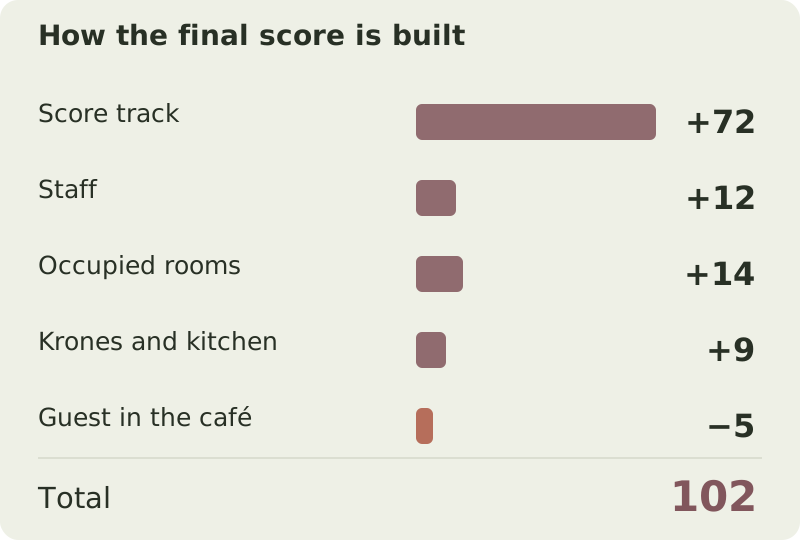
After the final Emperor Scoring the track shows 72. End-game staff scores 12. From bottom to top there are three, two, one and one occupied rooms: 3 × 1 + 2 × 2 + 1 × 3 + 1 × 4 = 14. Prepared but empty rooms are excluded.
Six krones and three kitchen items remain, totaling nine. One guest is still in the café, costing five. The total is 72 + 12 + 14 + 9 − 5 = 102. If an opponent also scores 102 but has eight krones and kitchen items combined, the example player wins the tie-break, nine to eight.
How to enter the figures
Enter room quantities 3, 2, 1 and 1 in the floor fields; their multipliers are automatic. Enter the already calculated 12 staff points. Enter nine reserves and one guest. Do not enter a five-point penalty as the guest quantity: the form would multiply that five by five again and incorrectly subtract 25.
Profile limitations
Preset starting staff and drafting change setup rather than this base scoring sequence. Let’s Waltz! and Leopold introduce their own rules, so this profile does not cover them. If players tie in both points and combined reserves, the calculator retains the same rank rather than inventing another criterion.
Mistakes that can change the winner
- Prepared empty rooms do not score floor points.
- Items placed on guests do not return to kitchen scoring.
- Do not award earlier staff and room-group rewards a second time.
Try it yourself
Try the example with your own numbers
Change the values to see how the score changes. This is a practice calculation; your saved game in the calculator is kept separately.
Questions & answers
Does a partly served guest still cost five?
Yes. If the guest card remains in your café, the full five-point penalty applies.
Which items count for the tie-break?
Remaining dishes and drinks in your kitchen plus krones; items on guest cards are excluded.
Sources and verification
Prepared by Board Game Scoreboard. Rules checked against the sources below on November 17, 2026; the worked example is checked during each site build. If editions differ, follow the rulebook included with your copy.
How we prepare our guidesReady to score your game?
Enter each player's results to see the total and a full breakdown.
Go to calculator ↗