Keep this handy at the table
Quick scoring reference
- Separate your Point Cards from the cards showing vegetables.
- Count each vegetable type and combine the fixed coefficients on your own cards.
- Evaluate complete sets; the same vegetables may be reused by different Point Cards.
- Check most/fewest and other conditions separately, then total the results.
Which side of a card scores at the end
At the end of the game, your tableau contains vegetables and Point Cards. A card flipped to its vegetable side no longer supplies its former scoring condition. Instead, it counts as an ordinary vegetable for the remaining Point Cards. Never score both sides of one physical card: that would turn a useful flipping decision into an extra scoring source the rules do not provide.
Sort the vegetables into six groups and count each once. Then read only your active Point Cards. An opponent’s condition does not automatically score for you even if your vegetables would satisfy it better. A vegetable named by none of your conditions has no intrinsic value, although it may still matter for an overall variety or quantity condition.
Combine fixed per-vegetable scores
If a card awards three per Carrot and subtracts two per Onion, multiply each vegetable quantity by its coefficient and combine the signed results. You can combine several such cards: add all fixed Carrot coefficients together, then do the same separately for the other five types. This is mathematically equivalent to evaluating those cards one at a time.
Do not include rewards for pairs, majorities or parity in a per-vegetable coefficient. Those depend on groups or comparisons rather than a fixed increment for each card. Five per pair of Carrots is not two and a half per Carrot: an incomplete remainder does not score, and the form accepts integer values matching the actual scoring categories.
Complete pairs, trios and reuse
For a set of different vegetables, the least available required ingredient limits the number of complete groups. Two Carrots, three Lettuce and four Tomatoes make two Carrot–Lettuce–Tomato trios. If a card requires a same-type pair, divide that quantity by two and discard the remainder. A vegetable absent from the condition cannot complete an otherwise incomplete pair.
Within the evaluation of one Point Card, each vegetable belongs to only one of its sets. After that card is scored, however, do not remove anything: the next Point Card again uses your whole collection. Five Carrots can therefore support Carrot pairs, mixed trios and fixed points per Carrot simultaneously. The conditions are independent rather than competing for a limited allocation of components.
Most/fewest and other special conditions
Cards rewarding the most or fewest require comparing the specified quantity with every opponent. A tied qualifying condition does not remove the award from the owner of the relevant Point Card; apply its scoring rule. This differs from dividing a shared prize pool among everybody. When a condition counts vegetables or types, identify exactly what it names before choosing an interpretation.
Check cards involving present or absent types, quantity thresholds, parity and other conditions separately. The calculator does not identify a card from its artwork or automatically evaluate every possible condition. Enter the resulting subtotal under other conditions, retaining a negative sign when needed. Keeping a per-card paper record makes this manual subtotal easier to audit.
Worked example: the same vegetables support three cards
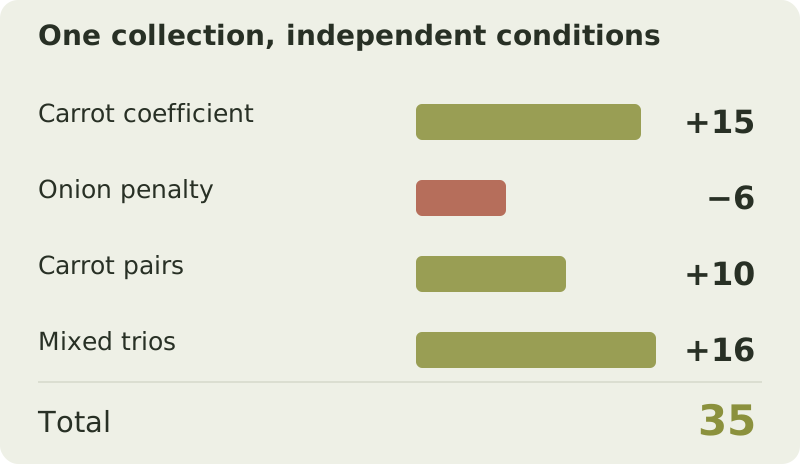
Take five Carrots, three Onions, two Tomatoes, three Lettuce and one Cabbage. For this exercise, use three scoring conditions: five points per Carrot pair, eight per Tomato–Lettuce–Carrot set, and three per Carrot minus two per Onion. No other conditions apply here, so the Cabbage has no independent scoring value.
The pairs make two complete groups worth ten. The mixed trios are limited by the two Tomatoes and score sixteen. Fixed coefficients give 5 × 3 − 3 × 2 = 9. The total is 35. All five Carrots contributed to the fixed category, four to pairs and two to trios. This is allowed because these are different Point Cards.
Work it out2 × 5 + 2 × 8 + 5 × 3 − 3 × 2 = 35 points
Specify a set’s composition in the form
Enter every vegetable quantity, then coefficient three for Carrots and minus two for Onions. For the pair, choose Carrot twice and enter five points per complete set. For the trio, choose Tomato, Lettuce and Carrot, then eight points. Do not enter ten and sixteen as the per-set values: the calculator determines the number of complete sets itself.
The form supports one pair composition and one trio composition. If several of your cards share the same composition, combine their per-set values. Calculate other compositions and larger sets separately and include them in other conditions. Do not duplicate pairs or trios already entered through the vegetable selectors. Also fill in actual turn order for the final tiebreaker.
Tied totals and the scope of this profile
When final totals are equal, the tied player who played later relative to the starting player wins. This is a separate tiebreaker, distinct from a tie on a most/fewest Point Card. The turn-order field adds no victory points. This profile covers the base game; standalone Point City, Point Galaxy and additional rules cannot use it merely because their names belong to a related family.
Common scoring mistakes
- Keeping the scoring condition of a card flipped to its vegetable side.
- Removing vegetables after scoring one card and withholding them from later cards.
- Confusing a negative coefficient with the positive quantity of vegetables.
- Repeating sets already calculated by the form under other conditions.
Try it yourself
Try the example with your own numbers
Change the values to see how the score changes. This is a practice calculation; your saved game in the calculator is kept separately.
Questions & answers
Can one Carrot count for several Point Cards?
Yes. Each Point Card independently uses your complete collection of qualifying vegetables. Within a set calculation for one card, each vegetable can be used only once.
Who receives a most-vegetables award when tied?
The owner of the qualifying Point Card receives its points when tied for the most. This does not create a shared award for players who do not own that card.
Sources and verification
Prepared by Board Game Scoreboard. Rules checked against the sources below on November 17, 2026; the worked example is checked during each site build. If editions differ, follow the rulebook included with your copy.
How we prepare our guidesReady to score your game?
Enter each player's results to see the total and a full breakdown.
Go to calculator ↗