Keep this handy at the table
Quick scoring reference
- After each round, count the dish cards by type before discarding them.
- Separate ordinary nigiri from those actually played onto wasabi.
- For maki rolls, enter the icons on each player’s cards.
- Keep Puddings across all three rounds and score them once at the end.
One round is not the whole game
The game lasts three rounds. Score each round’s dishes before discarding them and dealing new hands. A Sashimi from round one cannot be completed with two cards from round three: the earlier dishes have already finished scoring. Record the round in its own form section while the cards are still in front of the players, making both sets and maki comparisons easy to check.
Puddings are the exception: owners retain them between rounds until final scoring. Do not award six points for them after every round. Chopsticks and unused wasabi score nothing by themselves, so there are no quantity inputs for them. They can matter when checking that the played cards are legal, but they do not add another numerical scoring category.
Tempura, Sashimi and Dumplings
Every complete pair of Tempura scores five points. Three cards make one pair plus a worthless remainder; four make two pairs worth ten. Sashimi requires a trio worth ten, while one or two leftover cards add nothing. The calculator divides by the set size and uses only the number of complete sets.
Dumplings use one increasing table: one card scores one, two score three, three score six, four score ten, and five or more score fifteen. A sixth Dumpling does not start a new one-point group. This differs from Tempura: additional groups of five do not create repeated bonuses under the base rules.
Which nigiri are tripled by wasabi
Egg, Salmon and Squid nigiri normally score one, two and three points. When played onto wasabi they score three, six and nine. A wasabi applies to the next nigiri played onto it, not every nigiri in the round. Unused wasabi scores zero even when a suitable nigiri played earlier happens to be lying beside it.
Separate nigiri into six categories: three ordinary types and three on wasabi. Enter each card in exactly one category. The form does not choose an optimal arrangement after the fact; the actual placement shown by your tableau matters. A Squid nigiri on wasabi is one card in that input, not three ordinary Squid cards or nine precomputed points.
How maki and Pudding awards are split
Compare maki icons rather than the number of maki cards. First place scores six and second three. Tied players divide the relevant award, discarding any remainder. If first place is tied, nobody receives the second-place bonus. A sole leader therefore scores six while two tied runners-up receive one each from the three-point award, with the remaining point discarded.
At the end of round three, the most Puddings share plus six and the fewest share minus six, again discarding remainders. Zero Puddings counts when comparing the fewest. Two-player games have no negative Pudding award. If everyone has the same quantity, nobody gains or loses Pudding points. More Puddings break a tie on the overall game score.
Worked three-round example: 66 points
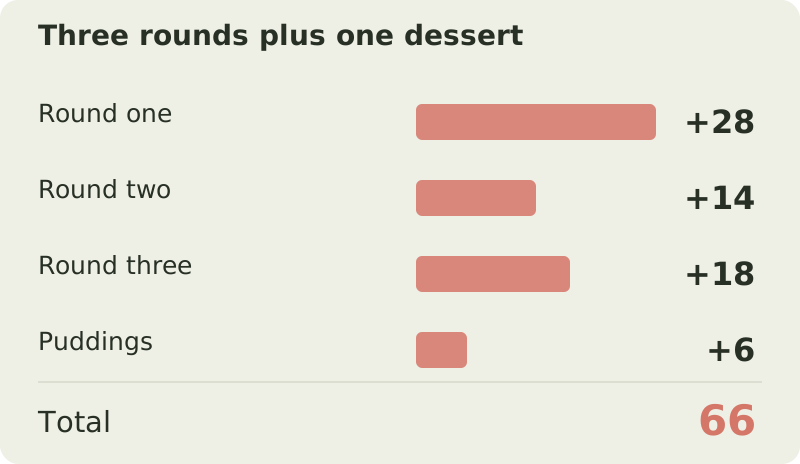
In round one, Anna collects two Tempura, three Sashimi, one Dumpling, a Squid nigiri on wasabi and two maki icons. Her dishes score 5 + 10 + 1 + 9. Her opponents have three and one maki icons, so Anna gains three for second place, totaling 28. Chopsticks or unused wasabi would add nothing.
In round two, three Dumplings, an ordinary Salmon and sole first place with four maki icons score 6 + 2 + 6 = 14; one Tempura and two Sashimi do not form sets. In round three, two Tempura, two Dumplings, an Egg, a Salmon on wasabi and tied first-place maki score 5 + 3 + 1 + 6 + 3 = 18. One Pudding against two opponents with none adds six, giving 66 overall.
Work it out28 + 14 + 18 + 6 = 66 points
Enter every player’s round quantities
Each round section takes card quantities, except the maki input, which takes icons. Do not put an already calculated round total into a dish field. Fill in the opponents’ same-round maki icons to distribute the award correctly. Enter Puddings as one cumulative quantity after round three. Until opponents’ quantities are filled, provisional bonuses may differ from the actual result.
The breakdown separates sets, nigiri, maki and dessert. If a result differs, first check nigiri on wasabi, then Sashimi remainders and maki splits. The form’s limits also help catch too many nigiri or more than six used wasabi in one round, but they do not replace checking the physical deal as a whole.
The original game and Party!
This profile uses the original deck’s dishes and the normal three rounds. Sushi Go Party! chooses a menu containing other dishes and scoring conditions, so sharing a few names does not make it compatible. If you have a different edition, check the Dumpling table, dessert distribution and maki rules. House rules changing awards likewise require a separately agreed calculation.
Common scoring mistakes
- Carrying incomplete Tempura or Sashimi sets between rounds.
- Entering nigiri on wasabi again as ordinary nigiri.
- Awarding second-place maki after a first-place tie.
- Applying a fewest-Puddings penalty in a two-player game.
Try it yourself
Try the example with your own numbers
Change the values to see how the score changes. This is a practice calculation; your saved game in the calculator is kept separately.
Three players. Boris’s maki icons by round: 3, 2, 3; Vera’s: 1, 1, 1. Neither has Puddings. These values remain fixed.
Questions & answers
What do six Dumplings score?
15 points. The table reaches its maximum at five cards; a sixth does not begin another set.
How do two tied runners-up split three maki points?
One point each, discarding the remainder. This second-place award exists only when first place was not tied.
Sources and verification
Prepared by Board Game Scoreboard. Rules checked against the sources below on November 17, 2026; the worked example is checked during each site build. If editions differ, follow the rulebook included with your copy.
How we prepare our guidesReady to score your game?
Enter each player's results to see the total and a full breakdown.
Go to calculator ↗