Keep this handy at the table
Quick scoring reference
- Finish all selected phases of the final round and the final discard.
- Add printed VP on worlds and developments in your tableau.
- Check each built 6-cost development’s scoring table separately.
- Add VP chips by denomination; record hand plus goods separately for ties.
What the end-game trigger means
The game checks its ending conditions at the end of a round. Depleting the VP-chip supply or reaching the required tableau size does not immediately cancel the other selected phases. Finish the final round’s required actions: new cards, goods and VP chips can still change the result before players compare scores.
The worlds and developments in front of you form your tableau. Cards in hand, future plans and discarded cards do not score their printed VP. Goods are usually represented by face-down cards on worlds: their card backs do not make them extra built worlds or developments. Keep these component groups separate until scoring is complete.
Printed VP is not construction cost
A card has a cost and a separate VP symbol. The ordinary scoring category uses the latter. A development costing three need not score three points. A military world likewise scores its VP symbol rather than its military requirement. Identify the correct symbol first, then total it across the relevant built cards.
Your starting world is part of the tableau and scores its own printed VP. Other cards do not lose points because they were built free or at a discount. Final value depends on their presence in the tableau and scoring text, not on how many cards you discarded to pay for construction.
Score the 6-cost developments
Six-cost developments often have variable VP defined by a scoring table. Work through one card’s table and identify its qualifying objects in your tableau. Check world types, power symbols and specific names where referenced. Worlds that look similar do not necessarily satisfy the same condition.
Repeat the procedure for each development. One object can legitimately contribute to different developments, but within a scoring table follow its actual conditions rather than adding every similar-looking symbol. Some developments count themselves; check the specific text. Do not automatically award six base points simply because the development costs six.
The calculator provides a separate field for the combined variable total. This preserves the distinction between ordinary printed VP and conditional awards. The form does not validate your tableau or discover card combinations automatically. Record each development’s subtotal before entering the combined figure so that the result can be checked if needed.
Victory-point chips by denomination
Count chips by value rather than by the number of cardboard pieces. Two five-point chips are worth ten, not two. If the normal supply runs out, still record points earned in the final phase using the prescribed replacement method. Your final chip total is not limited by how many one-point chips remained in the box.
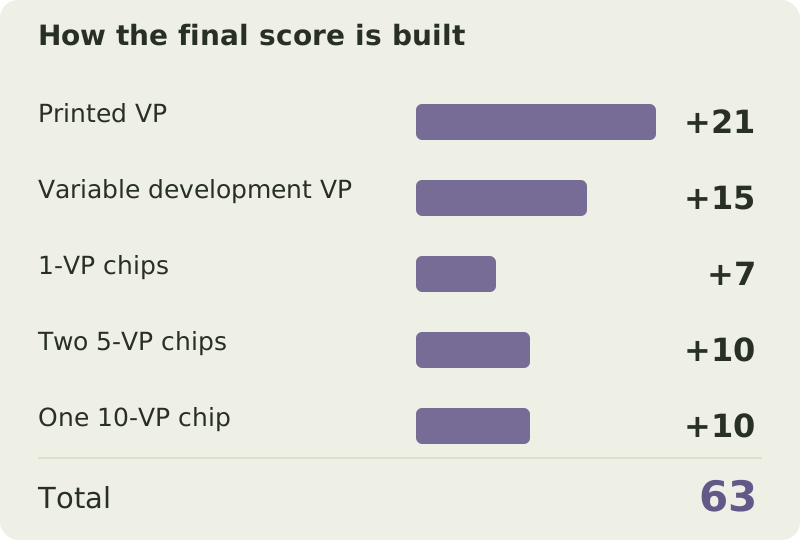
For example, seven one-point chips, two five-point chips and one ten-point chip total 7 + 10 + 10 = 27. Exchanging a ten for two fives does not change that value. Enter the actual quantities after making change, rather than recording both the original chips and their replacements.
Example: 63 points and a separate tie-break figure
The tableau provides 21 printed points. After checking their scoring tables manually, the 6-cost developments contribute another 15. The chips in the previous example are worth 27. The total is 21 + 15 + 27 = 63. The variable development subtotal is added once in its own category, not attached repeatedly to individual cards.
After the final discard, the player has six cards in hand and three goods on worlds, so the tie-break figure is nine. That does not turn 63 into 72. Against an opponent with 63 points and eight such components, nine wins the tie-break. If those totals also tie, victory is shared.
Using the form
Enter 21 printed VP, 15 variable development VP and chip quantities 7, 2 and 1. The separate hand-plus-goods field receives nine. All figures must be whole numbers. The saved session stores these entered totals; it is not a history of purchases, selected phases or cards discarded to pay for construction.
Expansions and other games in the series
The base game has no goal or prestige points. Expansions can add those categories, different end conditions and new effects, so this profile does not cover them completely. Roll for the Galaxy uses dice and its own scoring system; its rules do not transfer to this card-game form despite the similar names and shared setting.
What to double-check
- Do not add construction costs instead of VP symbols.
- Do not score hand cards as built tableau cards.
- Do not add the tie-break figure to the victory-point total.
Try it yourself
Try the example with your own numbers
Change the values to see how the score changes. This is a practice calculation; your saved game in the calculator is kept separately.
Questions & answers
Does a 6-cost development always score six points?
No. Cost is not VP; the particular development’s scoring table determines its variable value.
Do leftover goods give ordinary points?
Not automatically. They help break ties and may qualify for specific card-scoring conditions.
Sources and verification
Prepared by Board Game Scoreboard. Rules checked against the sources below on November 17, 2026; the worked example is checked during each site build. If editions differ, follow the rulebook included with your copy.
How we prepare our guidesReady to score your game?
Enter each player's results to see the total and a full breakdown.
Go to calculator ↗