Keep this handy at the table
Quick scoring reference
- Complete the third era’s Production and feed your connected cities.
- Score the final metropolis and cards, paying for their resource exchanges.
- Group connected cities by 0, 1, 2 or 3 different building types.
- Convert remaining biomatter to credits, then divide combined resources by four.
First resolve Production and feeding
The last Production still changes both resources and victory points. Resolve all active production effects, then feed the cities in your network. If you must spend biomatter or points instead of kelp, do so before starting final scoring. The calculator’s opening field uses the resulting score-track position.
Separate connected objects from disconnected ones. A built dome does not by itself belong to your network: trace a valid tunnel connection from the starting city. Keep the board assembled so you can inspect adjacent buildings and metropolis connections. Production points already recorded on the track are not new final-scoring bonuses.
Cities score building diversity, not building count
A connected city with no buildings scores two points. One building type scores three, two different types score four and all three types score six. The relevant types are farms, desalination plants and laboratories. Upgrading a building does not create another type: upgraded and ordinary farms are still farms for this category.
For example, a city with two farms and a laboratory has three buildings but only two types, so it scores four points. A city with a farm, laboratory and desalination plant scores six. Disconnected cities do not enter these groups, even when several upgraded buildings have already been built beside them.
The metropolis and end-scoring cards
Your final-scoring metropolis scores only when its connection requirement is fulfilled. The relevant brown metropolis on the base player board requires both tunnels. Then use that tile’s own formula: some effects count sets or particular upgraded structures. Do not replace that formula with a fixed reward for merely building a tunnel.
End-scoring cards may reward achievements or let you buy points with resources. Resolve the chosen exchanges first and reduce your resource supply. Enter the points gained in the card field and only the remaining resources in the resource fields. The same resource cannot pay for a card and also enter the ordinary final conversion.
Combine the remaining resources
Sell each remaining biomatter for two credits. Then combine credits, kelp, science and steelplast: any four units of that combined value score one point. Do not divide each resource separately. Three kelp and one steelplast already make one point, even though neither category individually reaches four.
Ignore any remainder below four. For example, seven credits, three kelp, two science, one steelplast and two biomatter give 7 + 3 + 2 + 1 + 4 = 17 units. That scores four points with one unit left over. The calculator performs both the biomatter conversion and the rounding automatically.
Example: an 85-point network
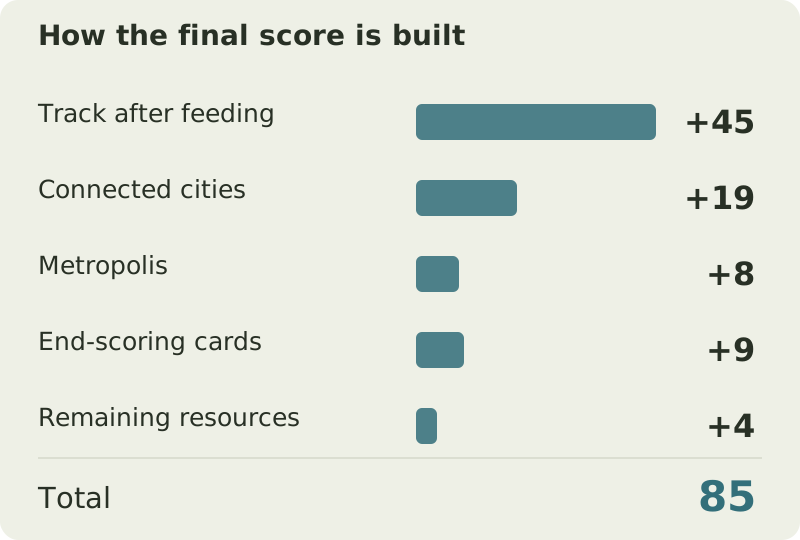
The track shows 45 after the final feeding. The network contains one city with no buildings, one with one type, two with two types and one with three types. Their value is 2 + 3 + 8 + 6 = 19. The final metropolis scores eight and cards score nine. The resource example above contributes four.
The full total is 45 + 19 + 8 + 9 + 4 = 85. Mistaking a city with two farms and a laboratory for one with three building types would add two incorrect points. Rounding small resource supplies separately can instead lose a valid point earned by their combined remainder.
Calculator fields and tied scores
Enter city quantities in the four city fields, rather than their calculated 2, 3, 4 or 6-point values. Metropolis and card fields take calculated totals. For tied scores, assign priority according to the actual player order: a higher Federation-track position gets a higher number. That field adds no points.
What the base profile covers
The profile covers the base game’s usual network categories and resource conversion. New Discoveries and other expansions may add objects or alter player abilities; check those effects separately. The practice form reproduces a fixed example and does not change your actual game saved in the main calculator.
Typical mistakes
- Do not count two buildings of the same type as two types.
- Do not score disconnected cities as part of the network.
- Do not spend the same resources on end-scoring cards and ordinary conversion.
Try it yourself
Try the example with your own numbers
Change the values to see how the score changes. This is a practice calculation; your saved game in the calculator is kept separately.
Questions & answers
Is an upgraded farm a separate type?
No. Ordinary and upgraded farms are the same building type.
Should each resource be divided by four separately?
No. After selling biomatter, combine all four resource types and only then divide by four and round down.
Sources and verification
Prepared by Board Game Scoreboard. Rules checked against the sources below on November 17, 2026; the worked example is checked during each site build. If editions differ, follow the rulebook included with your copy.
How we prepare our guidesReady to score your game?
Enter each player's results to see the total and a full breakdown.
Go to calculator ↗